
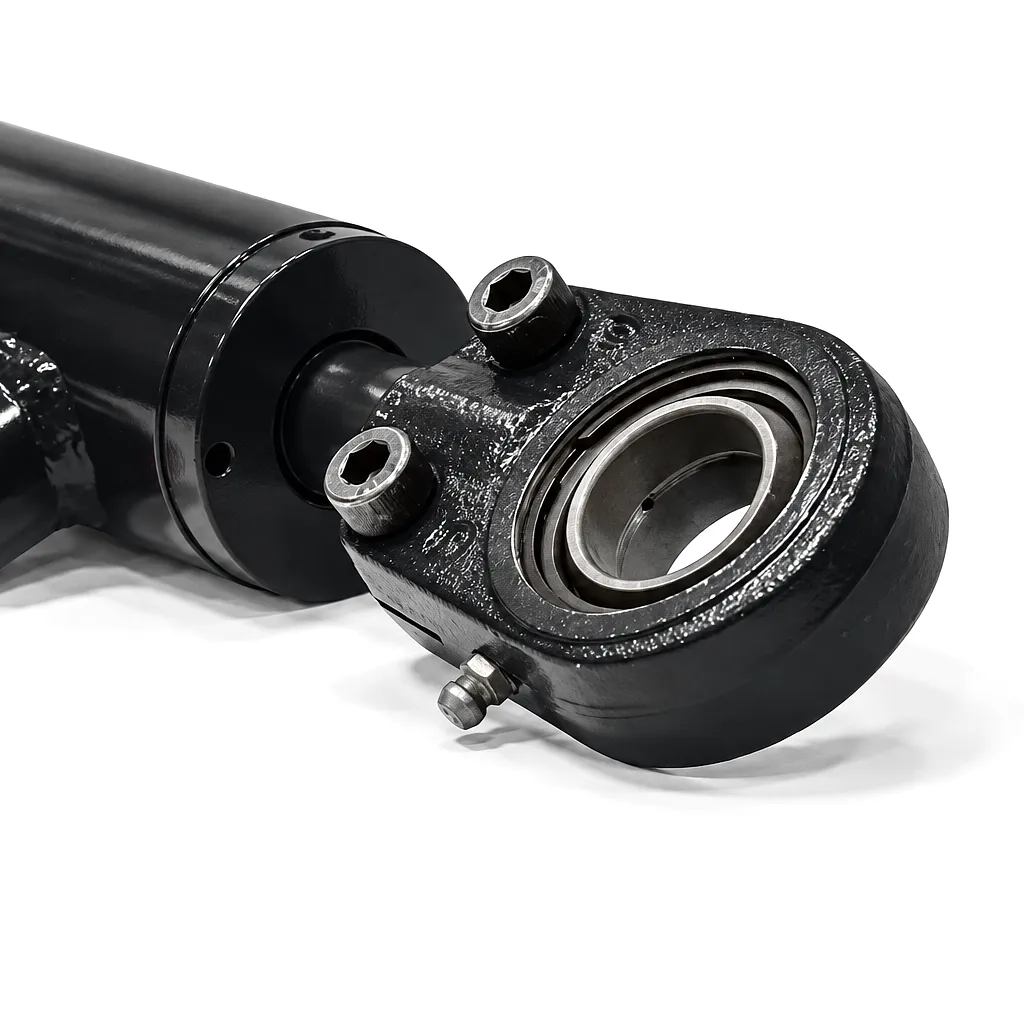
 The debate has run through purchasing departments across Birmingham, Sheffield, and Manchester for well over a decade. On one side sits the conventional wisdom that European hydraulic cylinder brands — German, Italian, Danish — represent the pinnacle of precision engineering, and that anything produced in China inevitably trades quality for price. On the other side, a growing body of UK manufacturers and plant operators who have quietly replaced their European hydraulic cylinder supply lines with Chinese alternatives and discovered that the real-world gap is far narrower — and in some specifications, entirely absent. This article cuts through the noise with engineering facts, material science, and performance data, helping British buyers make genuinely informed decisions rather than purchasing on reputation alone.
📌 Get a Quote — Contact Our Team
Response within 24 hours · Custom spec review included
How a Hydraulic Cylinder Actually Works — The Engineering Baseline
Linear Force Conversion
A hydraulic cylinder converts pressurised fluid energy into controlled mechanical force and linear motion. Pressurised oil enters the cylinder chamber, acting on the cross-sectional area of the piston to generate thrust. The fundamental equation is F = P × A, where F is the output force in kilonewtons, P is the hydraulic system pressure in bar, and A is the effective piston area in square centimetres. This elegant physics is identical whether the cylinder is manufactured in Wuhan or Wolfsburg — the engineering principles are universal and non-negotiable. What differs between manufacturers is precision in execution: bore tolerance, surface finish of the rod, seal geometry, and weld integrity.
Stroke, Bore, and Pressure Rating
Three parameters define a hydraulic cylinder’s capability: bore diameter, stroke length, and maximum operating pressure. A cylinder with a 100mm bore operating at 250 bar delivers approximately 196 kN of push force — enough to articulate a 25-tonne crane boom or power a baling press in a Lincolnshire agricultural operation. Stroke length determines the range of motion: cylinders used in aerial work platforms, such as the Folding Boom Angle Cylinder with 1458mm Stroke, require precision over a long travel distance to maintain positional accuracy at height. Any quality shortfall in honing or chrome plating compounds across the full stroke, creating seal wear that shortens service intervals dramatically.
The operating cycle of a double-acting hydraulic cylinder involves pressurising oil alternately in the extension and retraction chambers. Ports, valves, and the hydraulic power unit work in concert, but none of that system-level engineering compensates for a cylinder that leaks at the rod seal or exhibits barrel distortion under peak load. This is why the manufacturing process — from raw steel selection to final pressure testing — determines the cylinder’s real-world service life far more than the country of origin stamped on the body. The UK market has learned this over years of operational data, and progressive engineering firms from Sheffield’s steel fabrication sector to the maritime equipment builders along the Tyne are revisiting their supplier assumptions accordingly.
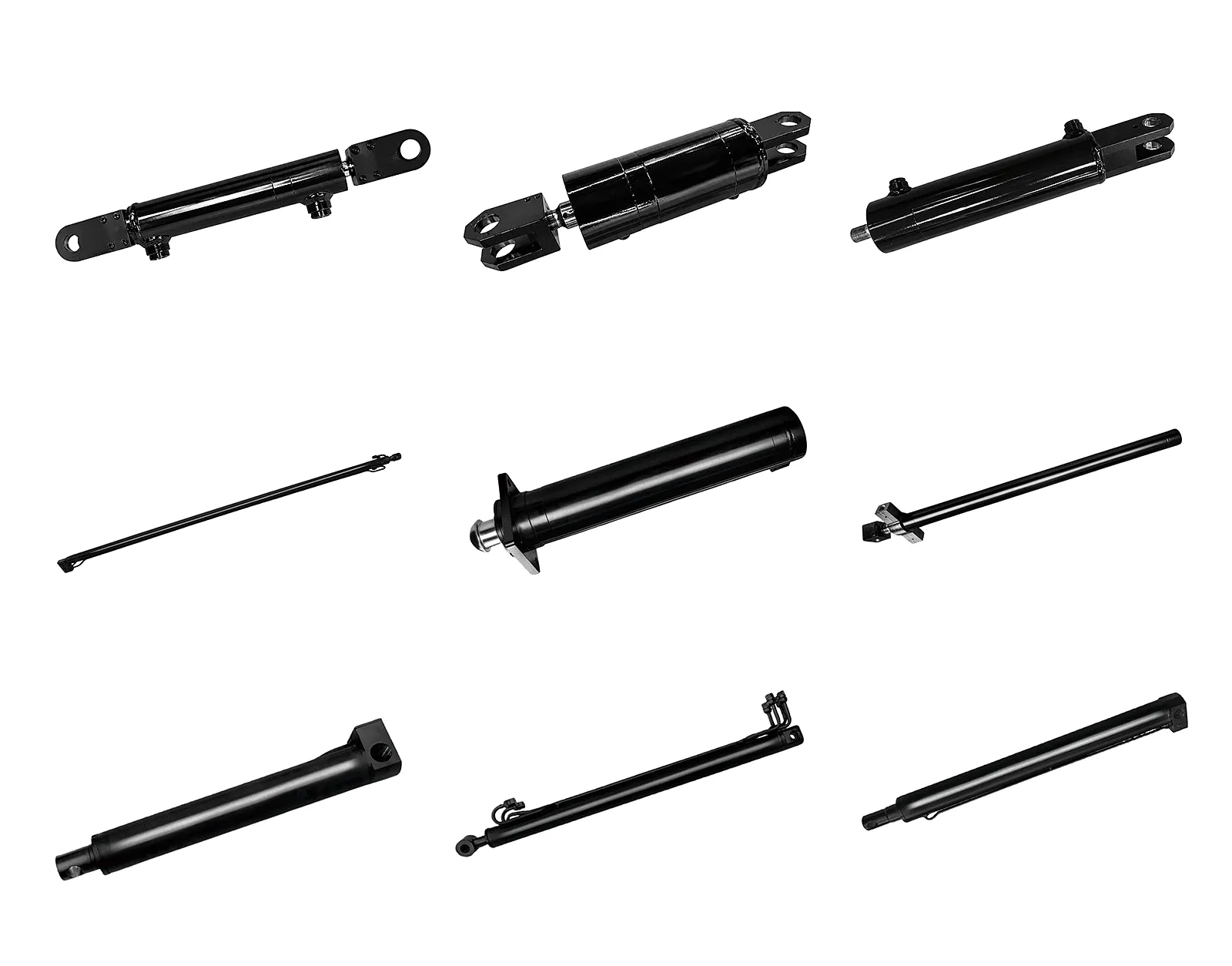
Material Science: Where the Quality Conversation Really Begins
Core materials used in precision hydraulic cylinder production
Cylinder Barrel — Cold-Drawn Seamless Steel
The barrel is precision honed to an internal surface roughness of Ra 0.2–0.4 µm using 45# cold-drawn seamless steel tube or ST52 equivalent (DIN 2391). The honing quality directly governs seal longevity: sub-Ra 0.4 µm finish reduces dynamic seal friction by up to 30%, directly extending service intervals. Leading Chinese manufacturers now routinely achieve these specifications on automated CNC honing lines, matching European equivalents on measurable surface parameters.
Piston Rod — Hard Chrome Plating
Piston rods are manufactured from 40Cr or 42CrMo4 alloy steel, induction-hardened to 54–60 HRC, then precision-ground and hard chrome plated to a minimum depth of 25 µm. The chrome layer must achieve a salt spray resistance of 96 hours minimum to BS EN ISO 9227 — a critical consideration for equipment operating in coastal environments around ports such as Southampton, Liverpool, and Bristol. Micro-crack density in the chrome layer, not mere thickness, determines actual corrosion barrier performance in salt-laden atmospheres.
Sealing Systems — Polyurethane and PTFE
Modern hydraulic cylinder sealing packages combine dynamic polyurethane rod seals, PTFE-backed guide rings, and NBR or FKM static O-rings. Temperature range capability spans -30°C to +120°C for standard grades, extending to -50°C for Arctic-specification variants. Chinese hydraulic cylinder manufacturers sourcing seal kits from Hallite, Parker, or NOK — all global standards bodies — produce cylinders with identical seal performance to their European counterparts. The seal brand, not the cylinder assembly country, is the dominant quality variable at this component level.
End Caps and Welds — Structural Integrity
End cap welding on hydraulic cylinders represents the single most safety-critical manufacturing step. Submerged arc welding (SAW) at certified parameters ensures full penetration welds with Charpy impact values above 27 J at -20°C, meeting EN 1011-2 requirements. This is where quality segmentation genuinely exists between manufacturers: certified weld procedures, automated weld monitoring, and post-weld pressure testing to 1.5× rated working pressure separate professional hydraulic cylinder manufacturers from budget commodity producers — regardless of nationality.
Hydraulic Cylinder Technical Performance Parameters
Reference specification range for industrial and mobile hydraulic cylinder applications
| Parameter | Rentang Standar | High-Performance Spec | Unit | Remarks |
|---|---|---|---|---|
| Diameter Lubang | 40 – 200 | Up to 500 | mm | ISO 6020/1 standard bores |
| Panjang Langkah | 100 – 3000 | Custom to 8000 | mm | Telescopic available |
| Tekanan Kerja | 160 – 250 | Up to 400 | bar | Test pressure 1.5× WP |
| Diameter Batang | 25 – 160 | Up to 320 | mm | h8 tolerance standard |
| Surface Hardness (Rod) | 54 – 58 | 58 – 62 | HRC | Induction-hardened 40Cr |
| Chrome Plating Depth | 20 – 30 | 35 – 50 | µm | Salt spray 96h min |
| Barrel Honing Roughness | Ra 0.3 – 0.5 | Ra 0.1 – 0.25 | µm | CNC diamond honing |
| Suhu Operasional | -20 to +100 | -50 to +150 | °C | FKM seals for high temp |
| Piston Seal Type | PU / NBR | PTFE / FKM | — | Parker / Hallite compatible |
| Mounting Style | Clevis / Flange | Trunnion / Spherical | — | ISO 6020/6022 |
| Certifications Available | CE / ISO 9001 | ATEX / DNV-GL | — | On request |
Featured Hydraulic Cylinder Products
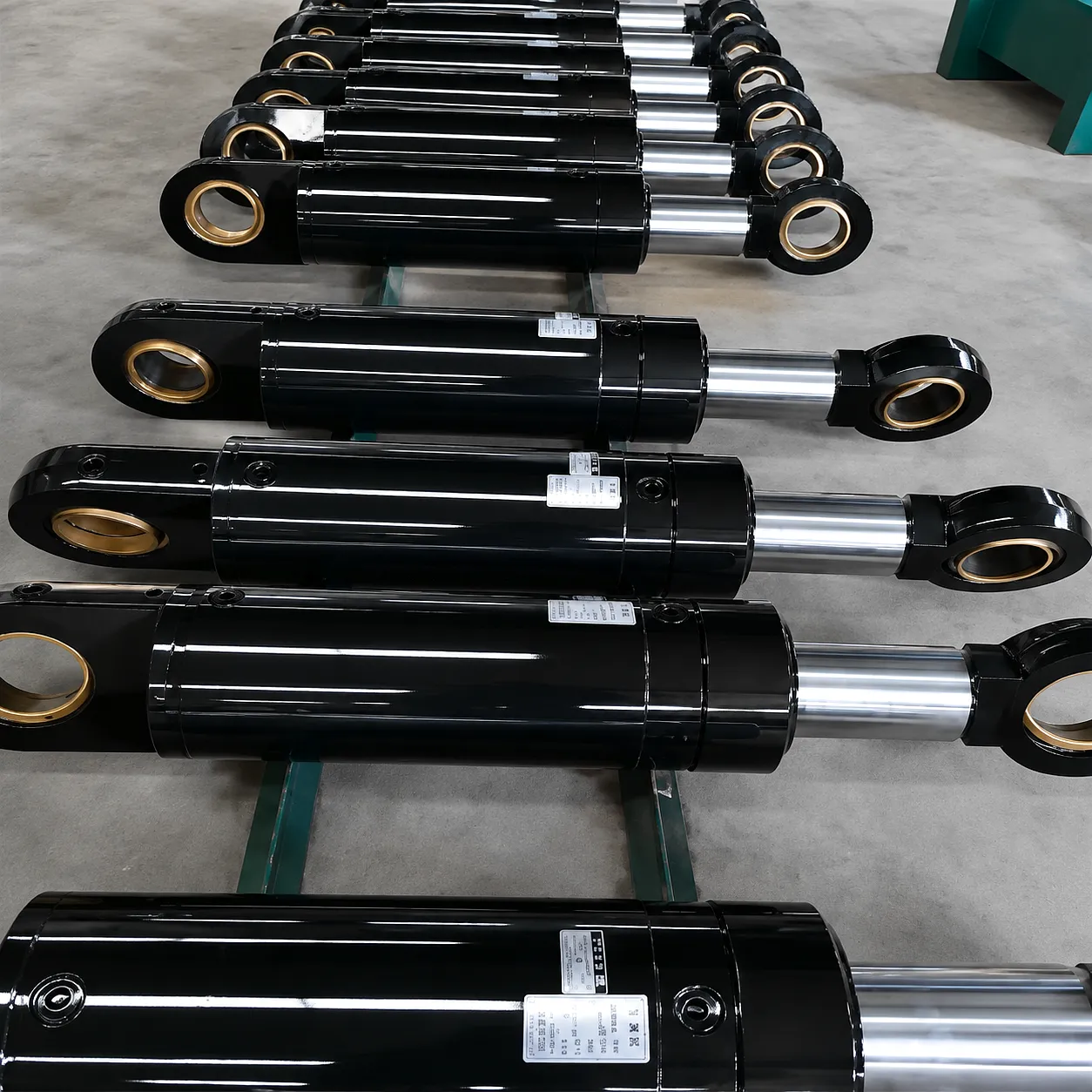
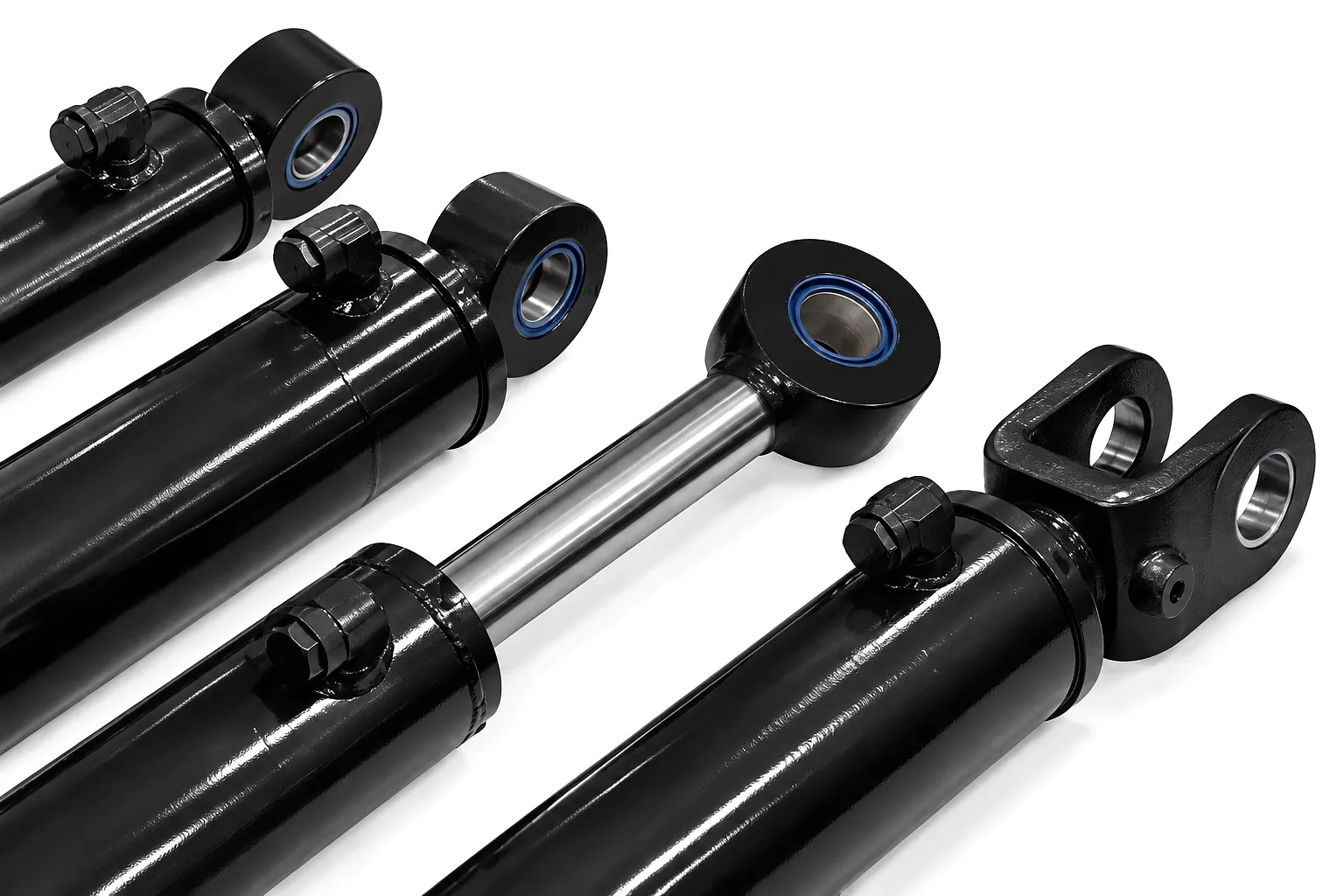
Debunking the Four Persistent Myths About Chinese Hydraulic Cylinders
Evidence-based analysis of common procurement assumptions held across UK industry
Core Technical Advantages of High-Grade Hydraulic Cylinders
Parameters that define long-term operational reliability in demanding UK industrial environments
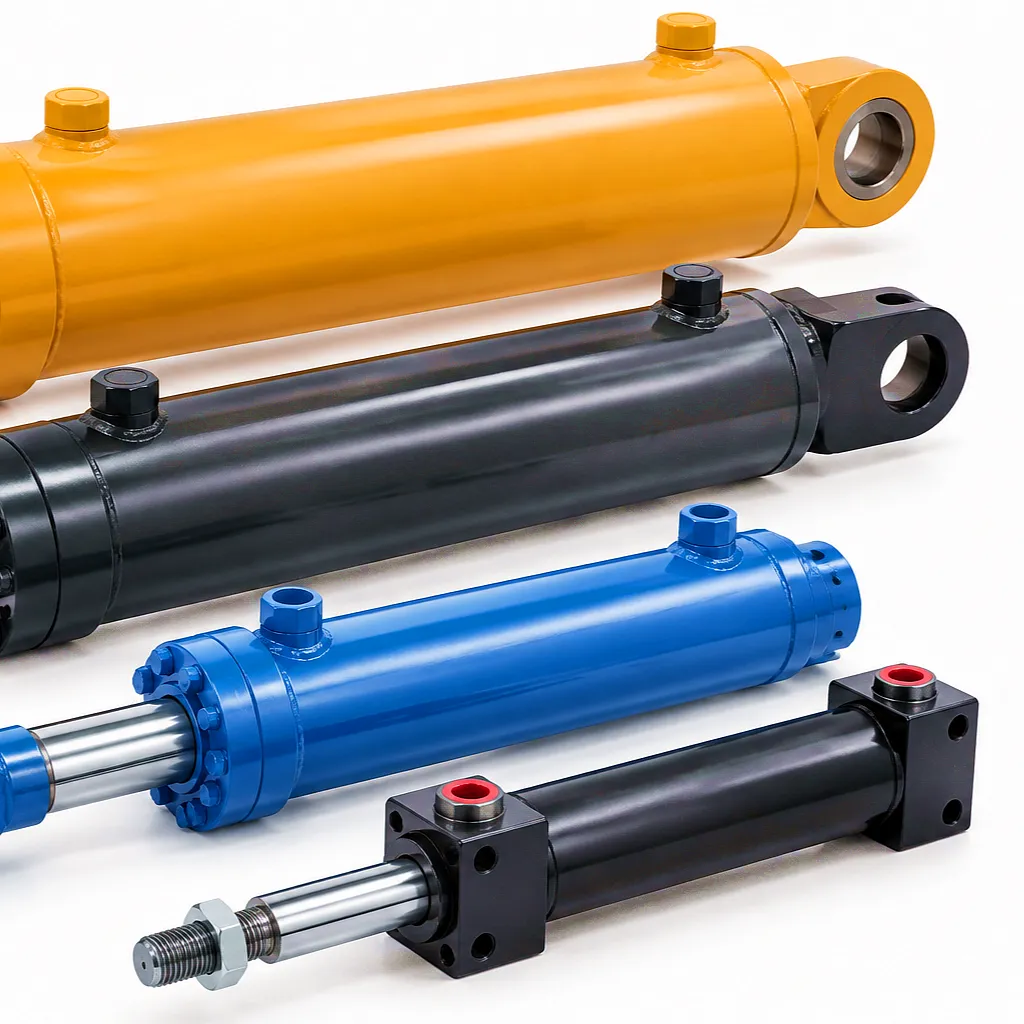
Zero-Leakage Rod Sealing
Multi-lip dynamic seal arrangements with integrated wiper rings prevent contamination ingress even in particulate-heavy environments such as quarrying operations in South Wales or aggregate processing plants in the Peak District. Tested to 5 million cycles without measurable bypass.
Cushioning at End-of-Stroke
Adjustable hydraulic cushioning decelerates the piston over the final 10–30mm of travel, eliminating shock loading on the end cap and structural mount. This extends the service life of boom pins and bushings on aerial work platforms and crane jibs, reducing maintenance costs across large equipment fleets.
High Buckling Load Resistance
Euler column buckling calculations per DIN 3320 govern rod diameter selection. A 70mm diameter rod in 42CrMo4 at 250 bar and 2000mm stroke safely carries lateral eccentric loading typical of angled lifting configurations without rod deflection exceeding 0.3mm/m length — critical for safe aerial platform operation.
Position Repeatability
Linear position transducer-compatible designs allow ±0.1mm positional repeatability when integrated with servo-valve hydraulic circuits. This level of control is increasingly demanded by UK automation integrators building custom handling cells and machine tools across the West Midlands manufacturing corridor.
Application Scenarios Across UK Industry
🏗 Construction — Aerial Work Platforms
Boom lift and scissor lift hydraulic cylinders face extreme duty cycles on UK construction projects — from city-centre high-rise developments in London’s Canary Wharf to infrastructure upgrades along the HS2 corridor. Boom angle cylinders must deliver smooth, jerk-free articulation under full rated load while tolerating pressure spikes generated by load-sensing hydraulic systems. Hydraulic cylinders operating in these environments must meet BS EN 280:2013 safety requirements for mobile elevating work platforms, with cylinders tested to 2× working pressure before deployment. Bore sizes from 63mm to 100mm, strokes from 400mm to 1800mm, cover the full range of articulated boom platform configurations in current UK fleet use.
🍏 Agricultural Machinery — East Anglia and Yorkshire
The UK’s agricultural machinery sector — concentrated in Lincolnshire, East Anglia, and Yorkshire — represents one of the most demanding hydraulic cylinder applications in terms of contamination exposure and operating cycle frequency. Tractor front-loader cylinders, combine header tilt cylinders, and baler plunger cylinders operate in environments saturated with silica dust, crop debris, and fertiliser-laden moisture. Hydraulic cylinders specified for agricultural equipment in this sector require IP69K-rated port protection, extended wiper seals, and anti-corrosion rod treatments capable of surviving the annual harvest season without service intervention. British agricultural OEMs including machinery assemblers around King’s Lynn and Spalding have progressively adopted Chinese hydraulic cylinder sourcing for harvest equipment, reporting seal change intervals comparable to their previous European-branded supply.
⛵ Marine and Port Equipment — Southampton and Bristol
Port crane hydraulic cylinders, harbour gate actuators, and ship ramp cylinders operating across Southampton’s container terminal, the Port of Bristol, and Teesport’s heavy lift facilities represent some of the most technically demanding hydraulic cylinder applications in the UK. Salt spray corrosion, tidal moisture cycling, and high-cycle-count requirements demand stainless steel rod options, zinc-nickel or PTFE composite coating on exposed components, and sealing compounds rated for seawater immersion. Hydraulic cylinders in marine port applications are typically engineered to Lloyd’s Register or DNV-GL marine standards — certifications that leading Chinese manufacturers hold alongside their ISO 9001 production qualifications.
🏭 Steel and Metal Processing — Sheffield and Rotherham
Sheffield’s advanced metals manufacturing sector, still one of the most technically demanding production environments in Europe, uses hydraulic cylinders throughout rolling mill pressure frames, forge press mechanisms, and metal cutting press lines. Cylinders in these applications operate at pressures up to 350 bar and temperatures exceeding 80°C, in environments with radiant heat from furnaces and metal chips contaminating hydraulic circuits. Rotherham steel processors operating 24-hour production schedules demand hydraulic cylinder MTBFs (Mean Time Between Failures) exceeding 10,000 operating hours — a target that both premium European and tier-1 Chinese hydraulic cylinder manufacturers can realistically achieve when cylinders are correctly specified and maintained.
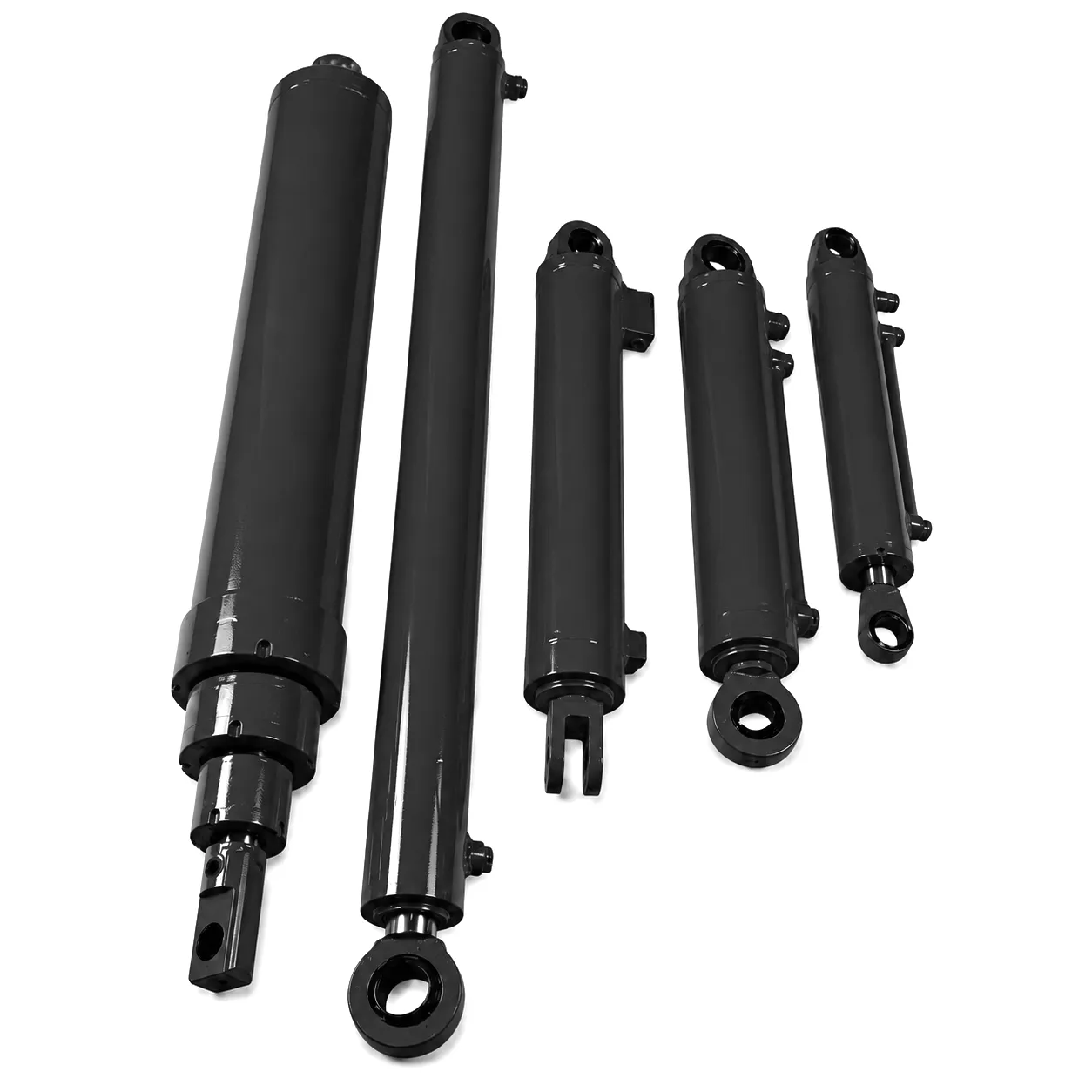
Customer Success Story: Birmingham Aerial Equipment Hire Fleet Overhaul
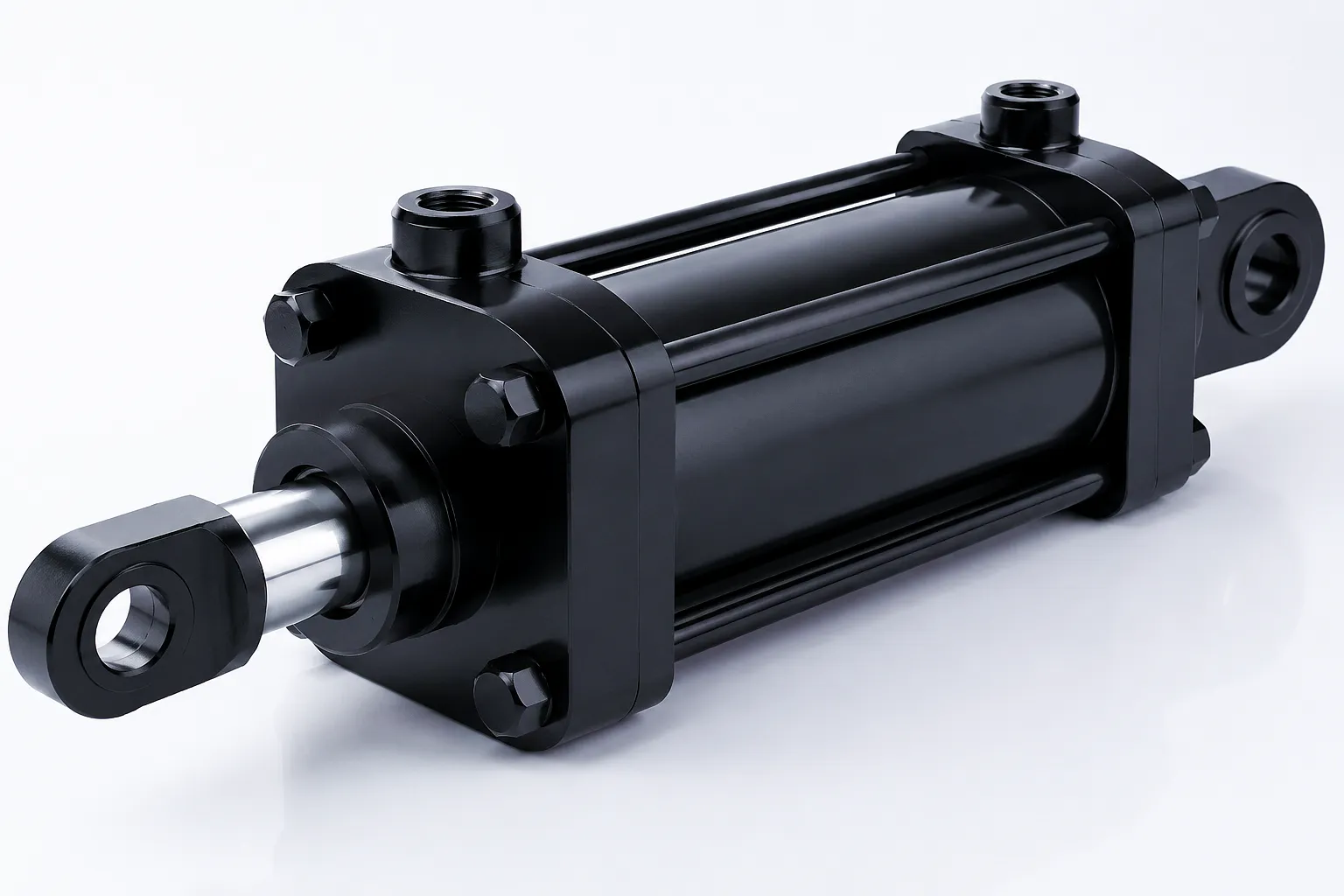 Midland Access Solutions Ltd operates a fleet of 68 articulated and telescopic boom platforms across the West Midlands, Worcestershire, and Warwickshire, serving construction contractors, stadium maintenance clients, and infrastructure engineers. By 2023, escalating service costs from their incumbent German-branded hydraulic cylinder supplier — including 14-week lead times on replacement boom angle cylinders and a 34% price increase driven by energy cost pass-through — had made their maintenance model financially unsustainable for mid-year budget cycles.
Their fleet manager initiated a structured product evaluation, sourcing replacement boom angle cylinders from Ever Power for a controlled trial on eight platforms operating at full hire utilisation across Birmingham’s ongoing city centre development zone. Over a 14-month trial period covering 28,000 combined operating hours across the test fleet, the Ever Power hydraulic cylinders demonstrated zero seal failures, rod surface finish measurements within Ra 0.3 µm at 14-month inspection, and no measurable bypass leakage on quarterly pressure drop tests. The trial results prompted a fleet-wide transition for all boom angle cylinder positions, covering 112 individual hydraulic cylinder replacements across their Birmingham, Wolverhampton, and Coventry depots.
The cost outcome across the two-year programme represented a 41% reduction in cylinder procurement spend versus the previous European supply chain, with service interval performance equal to or exceeding the benchmark set by the previous supplier. Ever Power’s engineering team provided full UKCA documentation, pressure test certificates, and dimensional drawings compatible with Midland Access Solutions’ existing maintenance management software, removing any administrative burden from the transition.
Customer Reviews
“We ran the rod surface finish check at 14 months as part of our annual LOLER inspection programme. The chrome on the Ever Power cylinders measured Ra 0.28 µm — tighter than our specification requirement. On our previous German supplier’s cylinders, we were seeing Ra 0.42 µm at 12 months on the same machines. The data speaks for itself.”
“Ever Power’s engineering team came back to us within a day with revised dimensional drawings when we flagged a pin bore tolerance issue that was specific to our Rotator mounting. That kind of responsive customisation was something we genuinely did not expect. They modified the clevis geometry and had confirmation samples shipped within 22 days. No European supplier has ever matched that turnaround on a custom draw.”
“The quote process was straightforward — we sent our existing cylinder dimensions and operating pressure spec, and received a detailed proposal with material certifications, test protocol outline, and pricing within 36 hours. Price for equivalent specification was 38% below our existing Bosch Rexroth supply price. After two years and zero warranty claims, the commercial case has been comprehensively proven.”
Pertanyaan yang Sering Diajukan
Common questions from UK procurement teams and plant engineers considering Chinese hydraulic cylinder supply
Ready to Evaluate Ever Power Hydraulic Cylinders for Your UK Fleet?
Send your specifications today. Our engineering team provides free technical review, custom quote, and full documentation package — typically within 24 hours.
 Indonesian
  English
  Italian
  Portuguese
  Dutch
Dutch  Swedish
  Danish
  Finnish
  Polish
  Hindi
Hindi  Kazakh
  Turkish
  Ukrainian
  Romanian
  Spanish
  German
  Russian
  Korean
  Japanese
  Vietnamese
  Thai
Thai  Malay
Malay  French
  Greek
Greek