
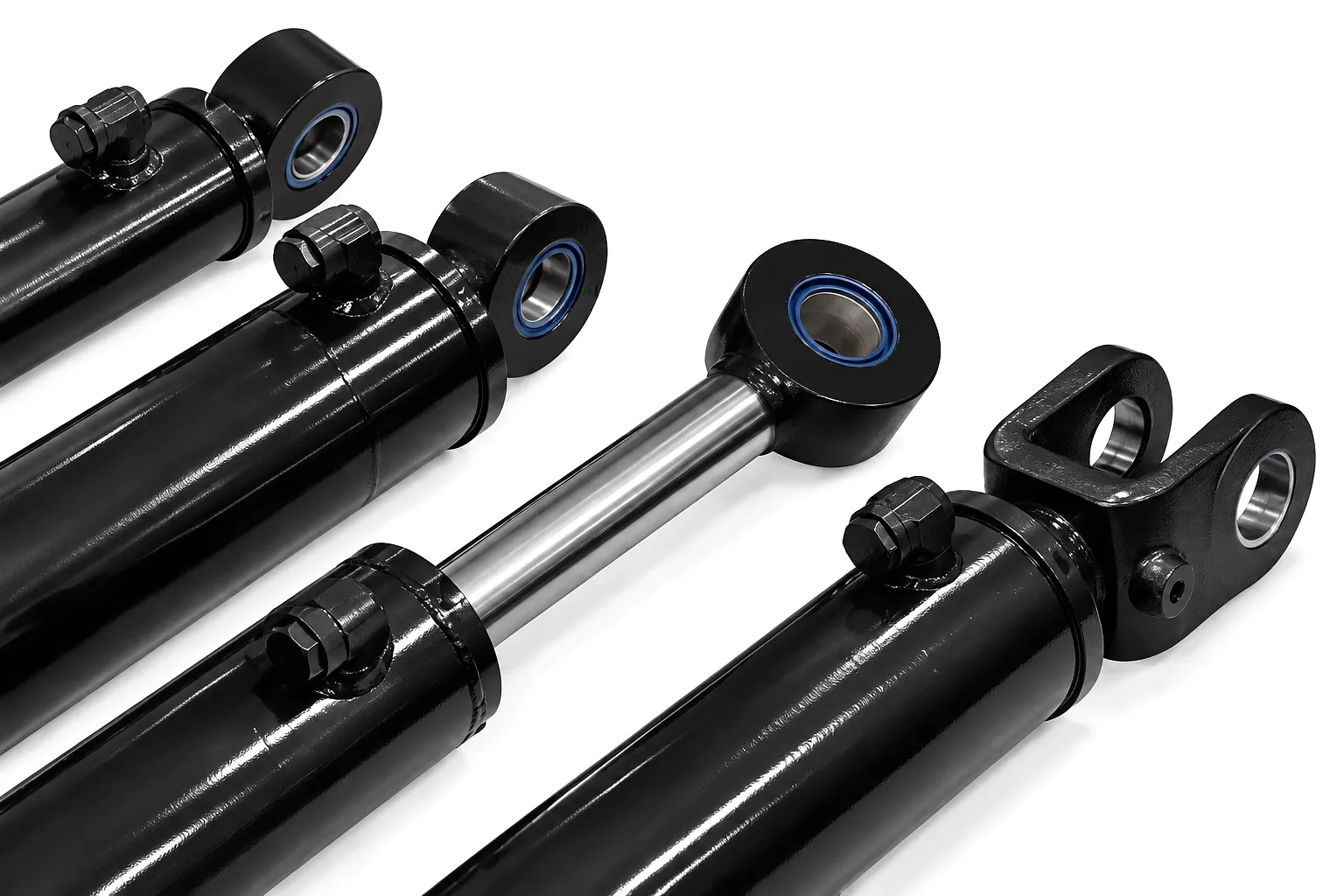
Understanding What You Are Installing
CYLINDER TYPE
Double-Acting vs Single-Acting
Double-acting cylinders use hydraulic pressure for both extension and retraction, making them standard in excavators, presses, and industrial manipulators. Single-acting cylinders extend under pressure and retract via spring or gravity — common on agricultural lift arms and clamping fixtures. Confirm which type you have before beginning work, as port configuration, bleeding procedures, and load-holding requirements differ substantially between the two. Misidentifying the type leads to incorrect hose routing, which creates immediate pressure imbalance and potential rod seal failure on first actuation. Check the cylinder manufacturer’s data plate and cross-reference with the original equipment schematic before removing any existing unit.
MOUNTING STYLE
Flange, Trunnion, Clevis & More
The mounting configuration determines how force is transferred into the machine structure and whether the cylinder is permitted to articulate or must remain rigidly fixed. Flange-mounted cylinders bolt directly to a flat surface and suit applications where the load travels in a single straight line. Trunnion mounts permit pivot motion and are prevalent in heavy boom applications where the cylinder must swing through an arc. Clevis mounts offer maximum articulation freedom and appear on agricultural implements, tailgate systems, and linkage arms throughout UK manufacturing. Match your mounting type precisely — forcing an incorrect mount into service creates bending moments the barrel was never designed to resist.
BORE & STROKE
Verifying Dimensional Specifications
Before installing any hydraulic cylinder, physically verify the bore diameter, rod diameter, and stroke length against your equipment’s bill of materials or the data plate on the unit being replaced. In UK manufacturing environments — particularly legacy equipment in the West Midlands and South Yorkshire metalworking sectors — imperial and metric dimensions often coexist on the same machine due to decades of incremental upgrades. A cylinder with a nominally similar bore but different rod diameter will change the system’s area ratio, altering force output, speed, and the relief valve pressure settings required to protect the equipment. This check takes two minutes with a calliper. Skipping it has cost far more than two minutes in unplanned downtime across countless UK workshops.
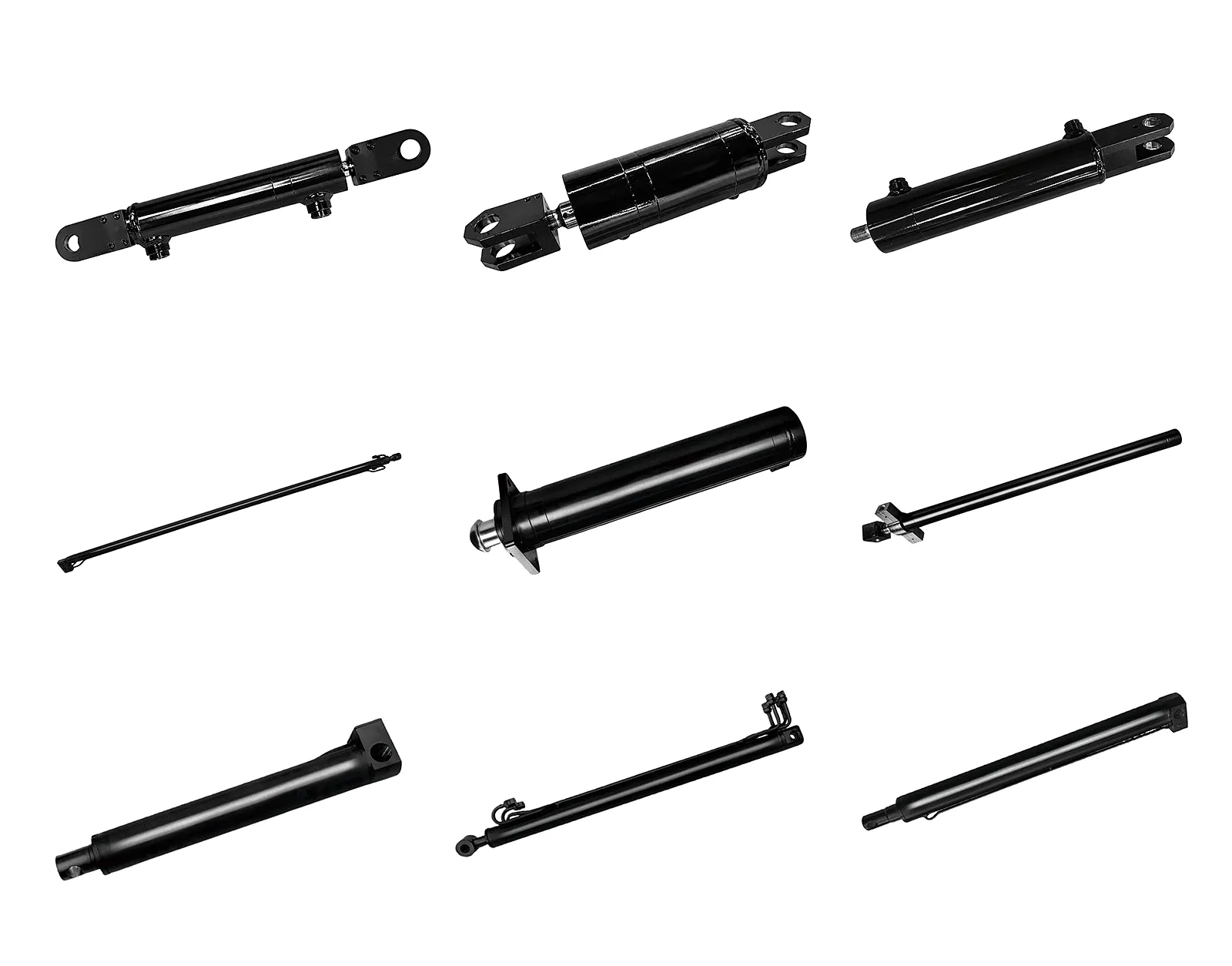
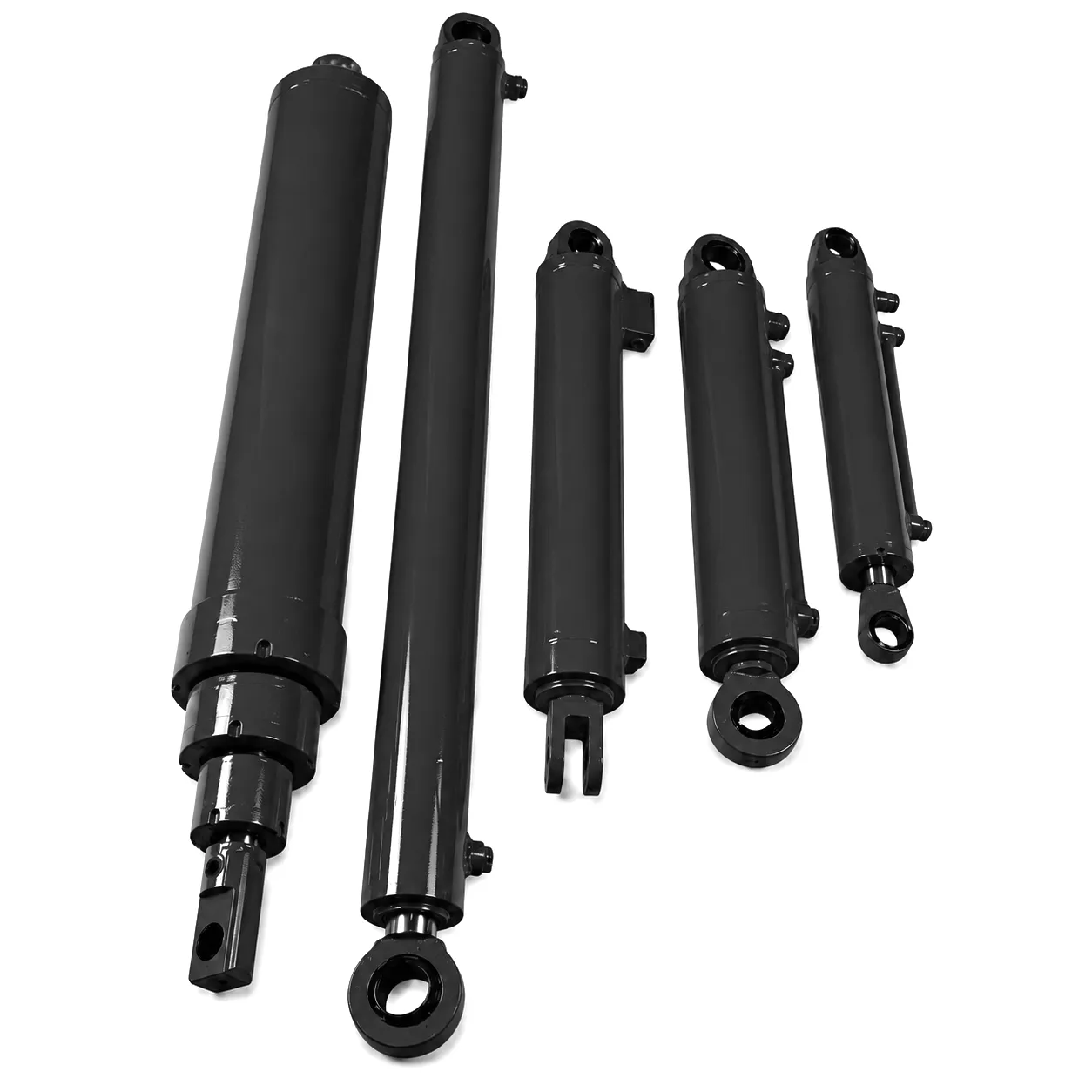
Ever Power Hydraulic Cylinder Product Range — Custom specifications available for all industrial sectors
Safety Requirements and Tool Preparation
No installation procedure is worth reading if it is not preceded by a safety briefing. Hydraulic systems store enormous amounts of energy in compressed fluid. A standard 250 bar operating system with a 63 mm bore cylinder holds enough force in its accumulator and hose network to cause severe, potentially fatal injury if improperly depressurised. In UK workplaces, the Provision and Use of Work Equipment Regulations (PUWER) and the Lifting Operations and Lifting Equipment Regulations (LOER) impose legal duties on employers and technicians to control risks when working on plant machinery. Beyond compliance, these are simply the correct practices developed through decades of hard lessons in the field. Read this section completely before touching any hydraulic fitting.
⚠ CRITICAL SAFETY NOTICE
Always isolate the power source and fully depressurise the hydraulic circuit before disconnecting any hose, fitting, or port plug. Verify zero pressure with a calibrated gauge connected at the relevant service port — never assume the system is safe because the pump motor is off. Accumulators retain pressure after pump shutdown. Always have a second person in the vicinity when working on high-pressure hydraulic assemblies. Wear rated eye protection, appropriate gloves, and ensure the load is positively supported by a mechanical means — never by hydraulic pressure alone — before beginning disassembly.
Gather the following equipment before starting. Attempting to improvise on hydraulic installations leads to damaged fittings, contaminated ports, and stripped threads that turn a straightforward replacement into a major repair job.
🔧 Hydraulic Tools
Calibrated torque wrench (rated to at least 300 Nm), hydraulic pressure gauge (0–400 bar), hose assembly equipment, BSPP/metric port adapters, thread sealant tape (PTFE), and hydraulic-grade O-ring lubricant. In UK installations, BSP (British Standard Pipe) port threads remain common on legacy plant and on locally-sourced hydraulic components — ensure your adapters match the port standard on the new cylinder before arriving on-site.
🛠 Mechanical Tools
Suitable lifting equipment rated for the cylinder’s weight (hydraulic cylinders above 100 kg stroke length are not a two-person lift without mechanical assistance), pin punches and drift punches for clevis pins, snap ring pliers, thread-cleaning taps and dies, and a surface plate or straight-edge for checking alignment. Steel-toed boots, EN 388 rated cut-resistant gloves, and EN 166 rated splash-proof eye protection are the minimum personal protective equipment for this task.
🧪 Cleanliness Supplies
ISO 4406 contamination control is not optional — it is the difference between a reliable installation and an early failure. You need clean lint-free cloths, hydraulic system flushing fluid, port caps and blanking plugs for all open ports during installation, a clean drip tray, and clean hydraulic oil of the correct ISO viscosity grade specified for your equipment. Contamination introduced during installation is responsible for a disproportionate share of premature cylinder failures in UK industrial operations.
Step-by-Step Installation Procedure
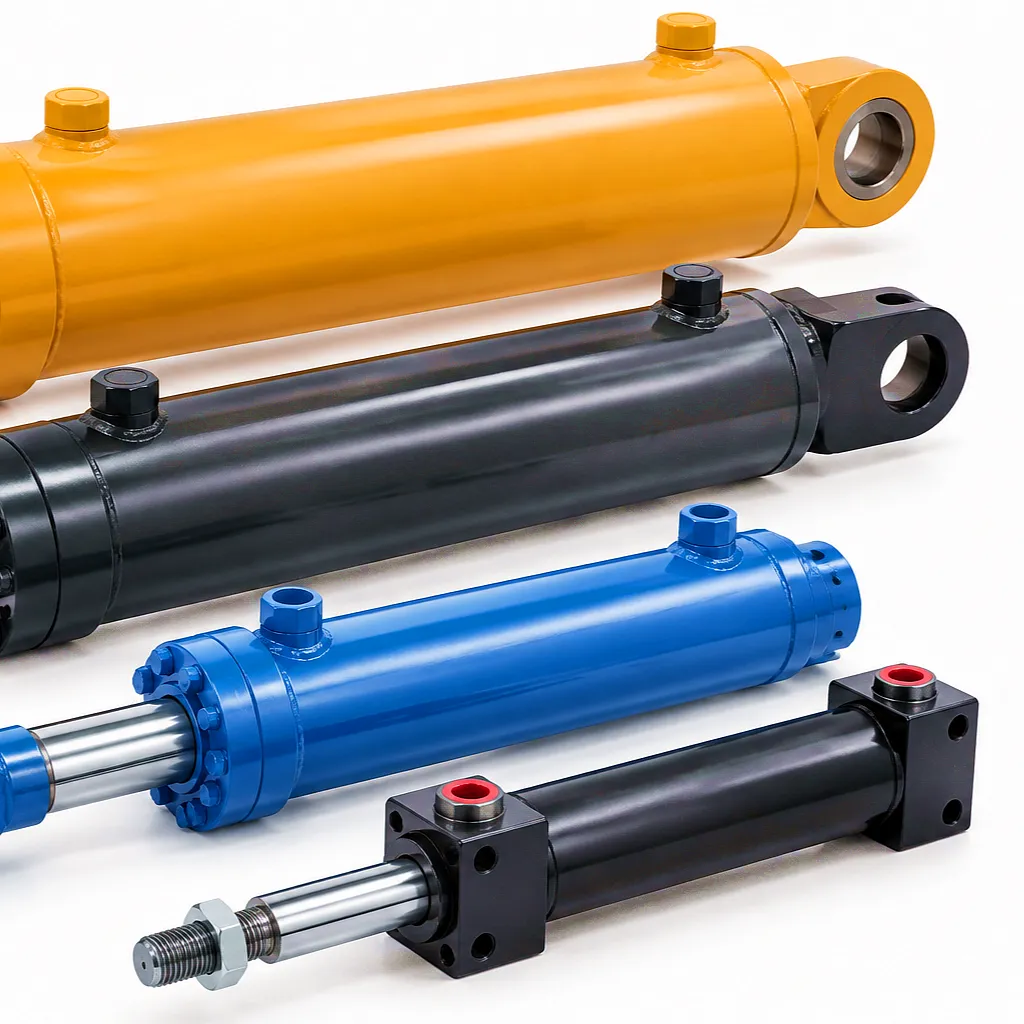
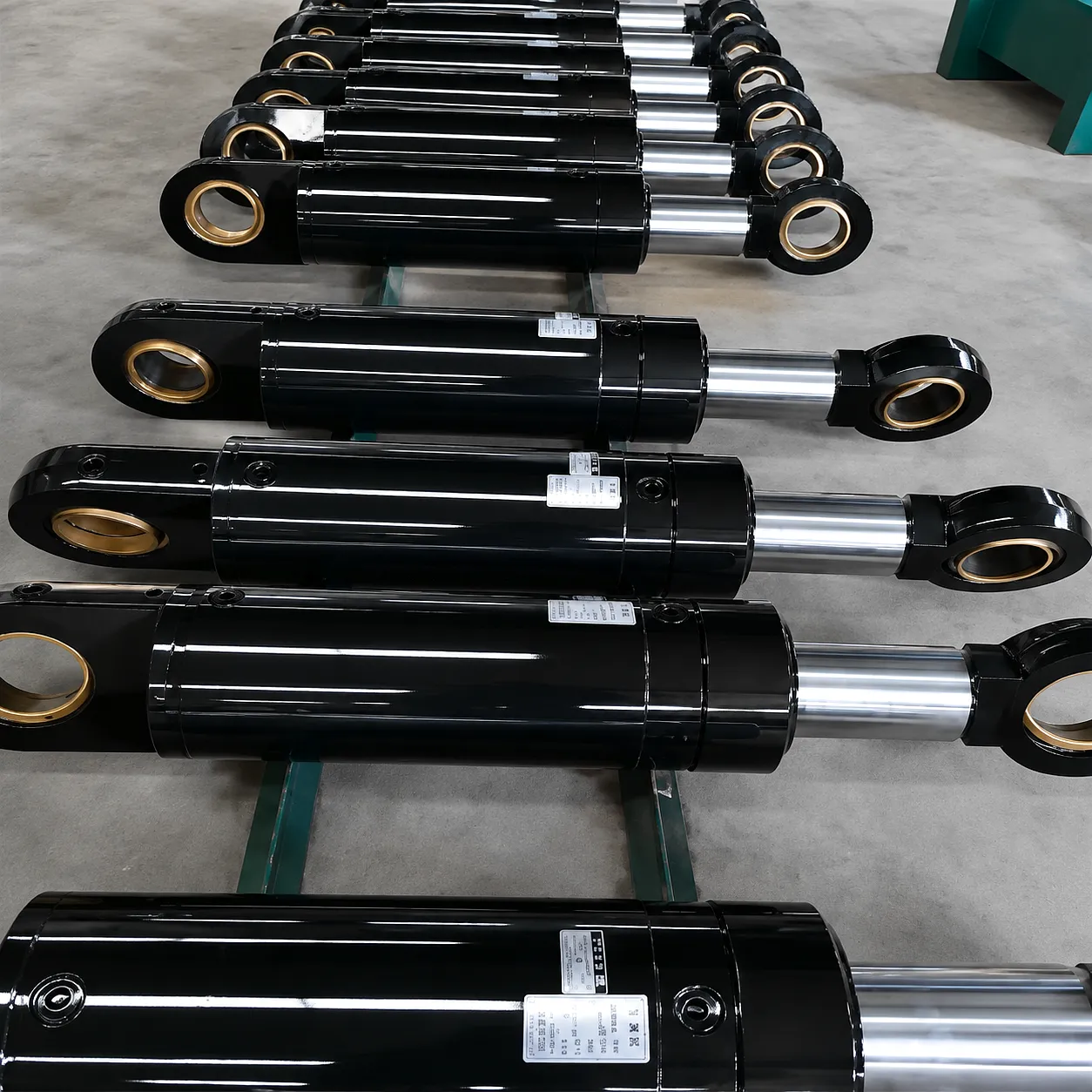
Follow this sequence precisely. Do not skip or reorder steps.
Commissioning and First-Run Procedure
Commissioning a newly installed hydraulic cylinder correctly determines whether it performs reliably for years or fails within days. This phase is where contamination is purged, air is removed from the circuit, and the sealing system is bedded in under controlled conditions. Rushing commissioning is one of the most common causes of premature hydraulic cylinder seal failure in UK industrial facilities. Budget at least 30 minutes for proper commissioning of a medium-bore cylinder, and more for large-bore or multi-stage telescopic units.
Bleeding Air from the Circuit
Air in a hydraulic circuit causes spongy, inconsistent cylinder movement, thermal degradation of the fluid, cavitation noise, and accelerated seal wear. With the system at low pressure (no-load conditions), slowly cycle the cylinder through its full stroke several times, pausing at each end of travel. Many hydraulic cylinders have bleed screws at the highest point in the circuit — open these a quarter turn to allow trapped air to escape as foam-contaminated fluid, then retighten before returning to operating pressure. On double-acting cylinders, bleed both the cap-end and rod-end circuits independently. Continue cycling until movement is smooth, consistent, and quiet throughout the stroke.
Initial Pressure Ramp-Up
Do not apply full system operating pressure immediately. Begin with the relief valve set to 25–30% of system working pressure, and cycle the cylinder ten full strokes at this reduced pressure. This allows the sealing pack to bed in gradually — particularly important for new polyurethane rod seals, which require several cycles to achieve their final seating geometry. After the low-pressure break-in, increase to 50% pressure and repeat. Only then bring the system to full operating pressure. This progressive ramp-up is standard practice on new installations by the hydraulic engineering teams at UK facilities producing high-cycle equipment such as metal pressing lines in the West Midlands and packaging machinery in the North West.
Leak Check and Final Inspection
At full operating pressure, hold the cylinder at each end of travel for a minimum of two minutes and visually inspect all port connections, hose ends, the rod seal area, and the gland nut area for any sign of weeping. Use clean tissue paper rather than your bare hand to detect seepage — hydraulic fluid under high pressure can penetrate skin through what appears to be a hairline weep. Hydraulic injection injuries are a medical emergency. Any seepage at hose connections should be addressed by re-torquing the fitting one quarter turn — not by overtightening. Any seepage from the rod seal at a newly installed cylinder indicates misalignment, a contaminated seal gland, or a damaged rod surface that must be investigated before returning the equipment to service.
Hydraulic Cylinder Technical Specifications Reference Table
The following table summarises typical technical parameters for industrial hydraulic cylinders across common UK applications. All specifications are subject to custom engineering — contact Ever Power for application-specific quotation.
| Parameter | Light Duty | Medium Duty | Heavy Duty | Mining / Offshore |
|---|---|---|---|---|
| Diameter Lubang | 25 – 63 mm | 63 – 160 mm | 160 – 320 mm | 320 – 800 mm |
| Diameter Batang | 16 – 40 mm | 40 – 110 mm | 110 – 220 mm | 220 – 560 mm |
| Operating Pressure | up to 160 bar | up to 250 bar | up to 350 bar | up to 500 bar |
| Panjang Langkah | 50 – 1,000 mm | 100 – 3,000 mm | 200 – 6,000 mm | Custom / unlimited |
| Bahan Laras | ST52 / ST52.3 steel | ST52.3 / E355 | E355 / 34CrMo4 | Duplex SS / Alloy steel |
| Rod Surface | Hard chrome 20–25 µm | Hard chrome 25–35 µm | Hard chrome 35–50 µm | HVOF / ceramic chrome |
| Seal Material | Nitrile NBR | Polyurethane PU | PU / PTFE composite | Viton FKM / PTFE |
| Port Thread Standard | BSP / metric | BSP / SAE / ORFS | SAE / ORFS | Custom per project |
| Mounting Torque Range | 20 – 80 Nm | 80 – 300 Nm | 300 – 1,200 Nm | Project-specific |
| Typical Applications | Agricultural, light plant | Manufacturing, transport | Press, forestry, marine | Mining, North Sea, civil |
Industrial Application Scenarios Across UK Sectors
🌿 Agricultural Machinery — Yorkshire & East Midlands
Hydraulic cylinders are central to UK’s agricultural machinery base. On round balers, combine harvesters, and forage equipment operating across Yorkshire’s arable plains and the East Midlands, cylinders actuate pick-up headers, bale chambers, feeding rolls, and ejection gates. See our hydraulic cylinders for combine harvesters — engineered for the dusty, high-cycle demands of harvest season. The installation stakes are high: a cylinder failure mid-harvest costs the operator not just a component, but potentially thousands of tonnes of standing crop. Correct installation, proper alignment, and using the right seal material for the dusty field environment are critical differentiators between a reliable harvest season and a costly breakdown.
🏢 Manufacturing & Pressing — Birmingham & West Midlands
The West Midlands remains one of the UK’s most concentrated manufacturing zones. Metal pressing lines, forge presses, and injection moulding machines throughout Birmingham, Coventry, and Wolverhampton rely on high-cycle hydraulic cylinders that must deliver precise, repeatable stroke lengths thousands of times per shift. These applications demand cylinders with tight bore surface finish tolerances (Ra 0.2–0.4 µm), high-quality polyurethane sealing systems, and accurately controlled cushioning at each end of stroke. Cushioning adjustment — the small needle valve located at each cylinder end — must be set during commissioning to decelerate the piston gradually in the final 15–20 mm of stroke, preventing hammering that damages mountings, cracks welds, and dramatically shortens seal life.
🚘 Transport & Lifting — UK Logistics Sector
Tail lifts on UK distribution lorries, vehicle mounted cranes (HIAB), and lorry-mounted tipper bodies all depend on hydraulic cylinders installed to exacting standards. The installation environment — often a roadside or depot workshop with limited equipment — makes correct procedure even more important. A double-acting telescopic hydraulic cylinder for lifting platforms fitted to a tail-lift assembly must be correctly bled, with its internal stage seals seated without air pockets, or the platform will sink under load — a direct safety risk to loading staff. Tail-lift hydraulic cylinders are subject to LOLER inspection in the UK, and a poorly installed unit will fail its six-monthly thorough examination, grounding the vehicle.
⚒ Steel & Heavy Industry — Sheffield & South Yorkshire
Sheffield’s remaining steel processing and specialist manufacturing operations use hydraulic cylinders in rolling mill pressing, forging press equipment, and metallurgical handling systems. These are among the most demanding environments for any hydraulic cylinder — high ambient temperatures, scale contamination, shock loading, and continuous duty cycles that stress every component to its engineering limits. In these applications, correct installation is only the starting point — the cylinder must be specified with adequate side-load rating, high-temperature seal compounds, and external rod protection to survive the environment. Ever Power’s engineering team works directly with Sheffield-based heavy industry clients to specify, manufacture, and commission cylinders that meet these punishing requirements.
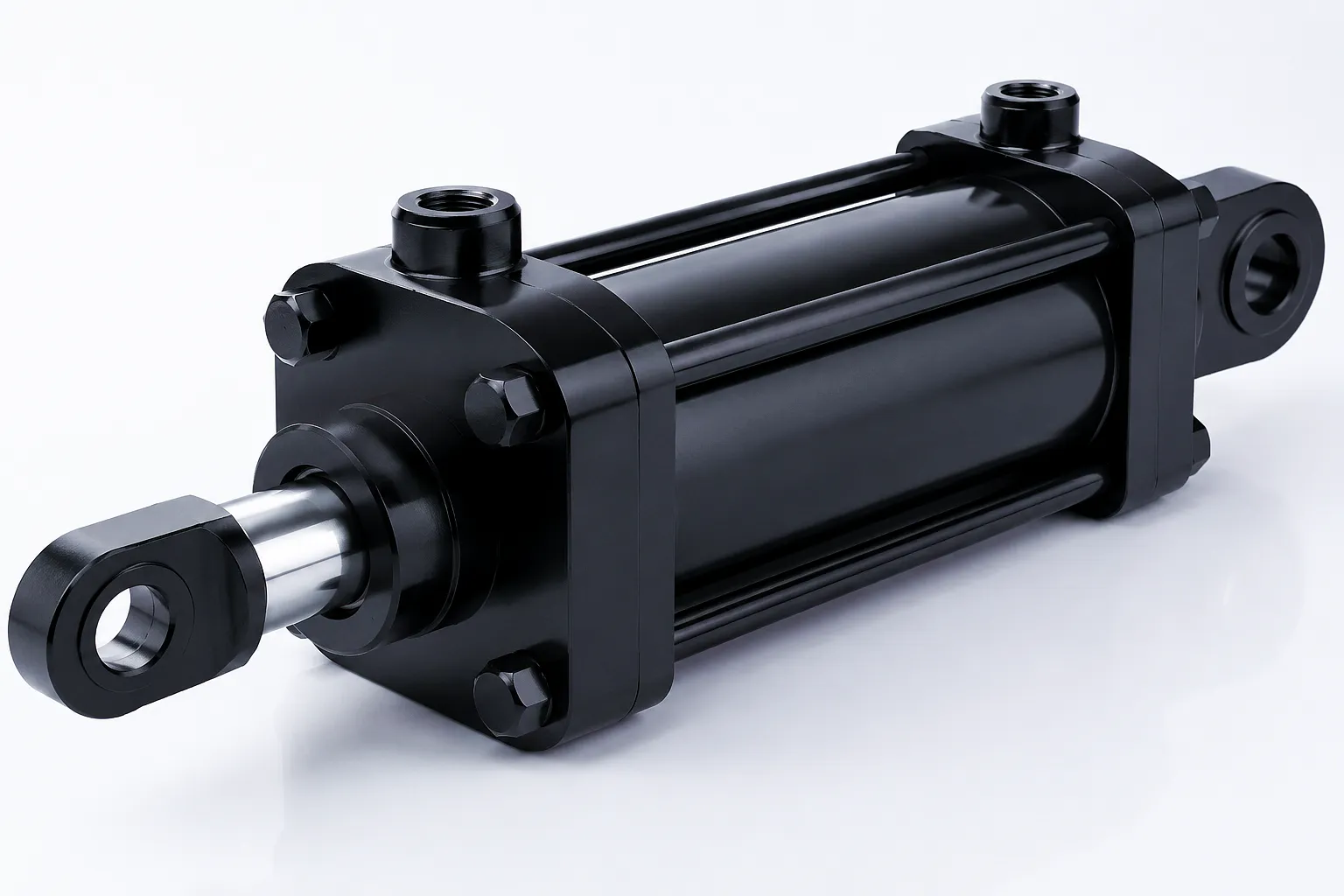
Ever Power: Precision Manufacturing & Custom Hydraulic Cylinder Supply
Your trusted UK B2B hydraulic cylinder partner — from single replacement units to full production line supply
⚙ Customisation Capabilities
Ever Power’s engineering team designs hydraulic cylinders from first principles — not adapted catalogue products. We work from customer drawings, OEM specifications, and application data sheets to produce cylinders that match your exact bore, stroke, port standard, mounting interface, and operating envelope. Our in-house machining capability covers bores from 25 mm to 1,000 mm and strokes to 8,000 mm. Seal material selection, surface treatment specification, and cushioning configuration are all engineered to the application, not assigned from a default. For UK customers requiring BSP port threads, EN standard materials certification, or ATEX-rated assemblies for hazardous environments, our production and documentation capability is fully aligned with UK and European industrial supply chain requirements.
📋 Precision Manufacturing Process
Every cylinder that leaves Ever Power’s facility is manufactured to tight dimensional tolerances and fully pressure-tested before despatch. Barrel bores are honed to surface finish Ra 0.2–0.4 µm — the benchmark for long seal life. Chrome rod surfaces are applied to controlled depth and hardness, then ground and polished to Ra 0.05–0.1 µm. Each assembly undergoes hydraulic pressure testing at 1.5x nominal operating pressure with zero permissible leakage, followed by dynamic cycle testing where specified. Material certifications, heat treatment records, and dimensional inspection reports are available for all production components — essential documentation for UK facilities operating under ISO 9001 quality management systems or BES 6001 responsible sourcing frameworks.
✈ Supply Chain & UK Logistics
Ever Power maintains a dedicated export logistics operation for the UK market. Standard cylinder assemblies typically ship within 7–14 working days from order confirmation. Custom-engineered units are quoted with specific lead times based on design complexity and material procurement requirements. All shipments arrive fully protected in custom-built timber crates or heavy-duty cardboard casing appropriate to the cylinder size and rod surface protection requirements. UK Customs commodity codes and CE documentation are provided as standard. For time-critical replacement situations — such as a harvest-season combine harvester breakdown or a production-line stoppage — Ever Power’s expedited despatch service can reduce lead times significantly when engineering resources permit. Contact our sales team to discuss your timeline.
Ready to discuss your hydraulic cylinder requirement?
Our engineering team responds within 24 hours on UK business days.
Customer Success Story: Sheffield Steel Processing Facility
Background
A specialist flat-rolled steel processing facility on the outskirts of Sheffield — producing precision strip steel for the UK automotive and aerospace supply chains — was experiencing repeated premature failures of the press-roll positioning cylinders on two of their cold-rolling mill lines. The cylinders, nominally rated to 280 bar with a 130 mm bore and 1,800 mm stroke, were failing at the rod seal within 6–8 weeks of installation — far below the expected 18-month service interval. The maintenance team had replaced three units in six months with identical catalogue cylinders from a European supplier, with identical results each time.
Ever Power’s UK sales engineering team was contacted in early spring and visited the Sheffield site within 48 hours of enquiry. The on-site assessment immediately identified two root causes: the mounting bracket design was introducing approximately 1.8° of angular misalignment at mid-stroke due to a flexing sub-frame, and the seal specification being used — a standard polyurethane rod seal — was incompatible with the mill’s water-based rolling lubricant, which was slowly degrading the seal compound from the outer wiper inward.
Ever Power designed a replacement cylinder with a modified trunnion mounting geometry that accommodated the frame flex through a controlled spherical bearing arrangement, eliminating the angular misalignment entirely. The sealing system was redesigned around a Viton FKM rod seal with a PTFE-backed primary seal, fully compatible with the water-based emulsion environment. The replacement units were engineered, manufactured, and delivered to the Sheffield facility within 19 working days. Installation was carried out by the client’s own maintenance team following Ever Power’s written installation procedure — specifically the alignment verification and progressive pressure commissioning steps described in this guide.
Both rolling lines have now been running continuously for fourteen months without a single cylinder-related stoppage. The estimated saving in unplanned downtime, replacement parts, and lost production over that period — compared with the previous failure pattern — exceeds £340,000 at the facility’s standard downtime cost rate. The Sheffield engineering team now specifies Ever Power cylinders as standard for all press-roll positioning applications across their three UK plants.
What UK Customers Say About Ever Power Cylinders
★★★★★
“The rod seal life on the Ever Power units has been exceptional. We’re running 280 bar continuous with a water-emulsion lubricant — an environment that destroys standard cylinders quickly. Fourteen months and zero seal failures. The engineering support during specification was thorough and genuinely knowledgeable. I’d recommend them to any UK manufacturer dealing with aggressive hydraulic environments.”
— Senior Maintenance Engineer, Steel Processing Facility, Sheffield
★★★★★
“We ordered custom clevis cylinders for our round baler production line — non-standard stroke, non-standard bore, BSP ports, and a tight lead time ahead of the season. Ever Power hit every specification and delivered on time. The installation documentation they provided was clear and practical — our field team found it far more useful than the generic datasheets we’d been using. We’ve placed repeat orders for two further harvesting equipment programmes.”
— Head of Procurement, Agricultural Machinery Manufacturer, Lincolnshire
★★★★★
“We maintain a fleet of lorry-mounted lifting platforms across the UK Midlands. The telescopic cylinders from Ever Power have gone through our LOLER inspections with no issues — the build quality and dimensional accuracy is genuinely better than what we were previously sourcing from Germany at a higher price. Their response time on technical queries is fast, and the material certification pack is comprehensive. That matters when you’re dealing with the inspection regime we operate under.”
— Fleet Maintenance Manager, Logistics Company, Birmingham
Pertanyaan yang Sering Diajukan
Real questions from UK technicians and procurement teams — answered directly.
Silinder Hidrolik Ever Power
Custom hydraulic cylinder manufacturing and supply for UK B2B markets · [email protected]
diedit oleh gzl
 Indonesian
  English
  Italian
  Portuguese
  Dutch
Dutch  Swedish
  Danish
  Finnish
  Polish
  Hindi
Hindi  Kazakh
  Turkish
  Ukrainian
  Romanian
  Spanish
  German
  Russian
  Korean
  Japanese
  Vietnamese
  Thai
Thai  Malay
Malay  French
  Greek
Greek