
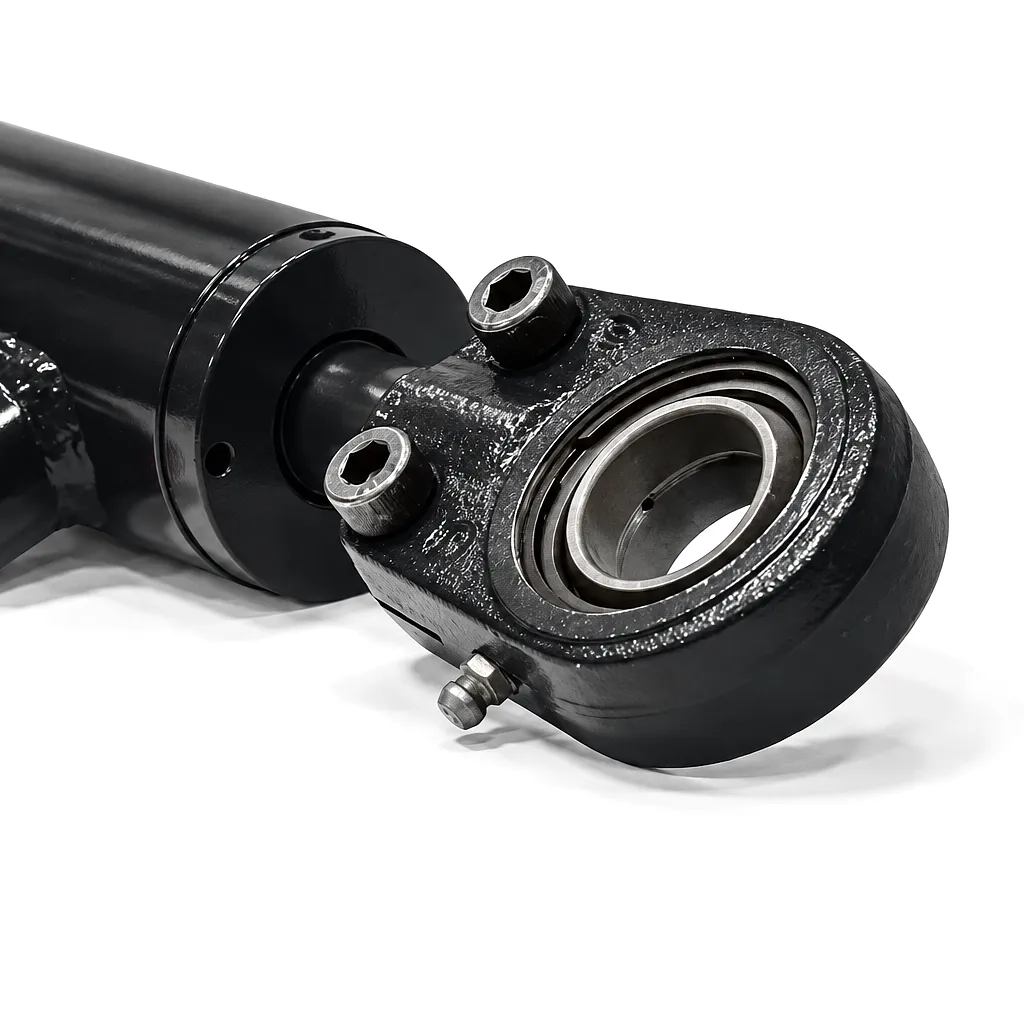
 Walk around any working plant in Birmingham, Sheffield, or the Humber industrial corridor and you will find hydraulic cylinders doing the heavy work — pressing, clamping, lifting, steering, and tilting loads that no other actuator handles as efficiently. When a cylinder rod takes a hit, buckles under a side load, or bends gradually through misalignment, the decision that follows carries real financial weight. Repair it in-house? Send it to a rod repair specialist? Or pull the assembly and replace it outright? The answer is rarely obvious, and choosing poorly in either direction costs money — through wasted rebuild labour, unexpected downtime, or premature component failure that puts both machinery and personnel at risk.
This guide works through that decision systematically. It draws on hydraulic engineering fundamentals and real-world maintenance practice to give UK engineers the technical framework they need — covering how to assess rod damage, what material and geometry factors determine repairability, where repair crosses the line into false economy, and what to look for in a quality replacement cylinder. The standards referenced throughout reflect HSE guidance and BS EN ISO requirements relevant to UK industrial environments.
How Hydraulic Cylinder Rods Bend — and Why It Matters for Your Decision
Sudden Impact Bending
This happens when a rod takes a direct lateral strike — a tipping load catching the extended rod, a vehicle collision in a mobile application, or a dropped component in a press shop. The damage is often visible as a sharp kink rather than a gentle curve. Metallurgically, the chrome-plated surface cracks at the point of maximum stress, and if the rod is made from induction-hardened bar stock, the brittle outer case may separate entirely from the core. Impact bending almost always creates subsurface work-hardening gradients that cannot be measured with a straight-edge alone — they require dye penetrant inspection or magnetic particle testing to characterise safely.
Progressive Misalignment Bending
Far more common in long-term plant maintenance records is the gradual bow that develops when a cylinder is mounted with angular misalignment, when pivot pins wear and introduce consistent offset loading, or when the rod operates near its theoretical Euler buckling limit cycle after cycle. This type of damage appears as a gentle curve distributed across the full rod length. The chrome plating may still look intact, but the underlying bar will have accumulated residual compressive stresses on the concave face and tensile damage on the convex side. Seals suffer first — uneven contact forces accelerate rod seal wear, and the first maintenance symptom is often external leakage rather than visible rod deformation.
Corrosion-Assisted Deformation
In UK coastal and offshore-adjacent environments — think Teesside, Grimsby dockside, or Fife fabrication yards — aggressive chloride-laden atmospheres attack chrome plating at pinholes and micro-cracks. Once the base steel is exposed, hydrogen embrittlement from the corrosion reaction can cause a rod to fracture under loads well below its rated capacity, even where the rod appears only mildly bent. This failure mode is particularly treacherous because the external evidence understates the internal damage. Any rod exhibiting pitting corrosion combined with any degree of visible bend must be treated as a replacement candidate rather than a repair candidate, regardless of how minor the curvature looks to the naked eye.
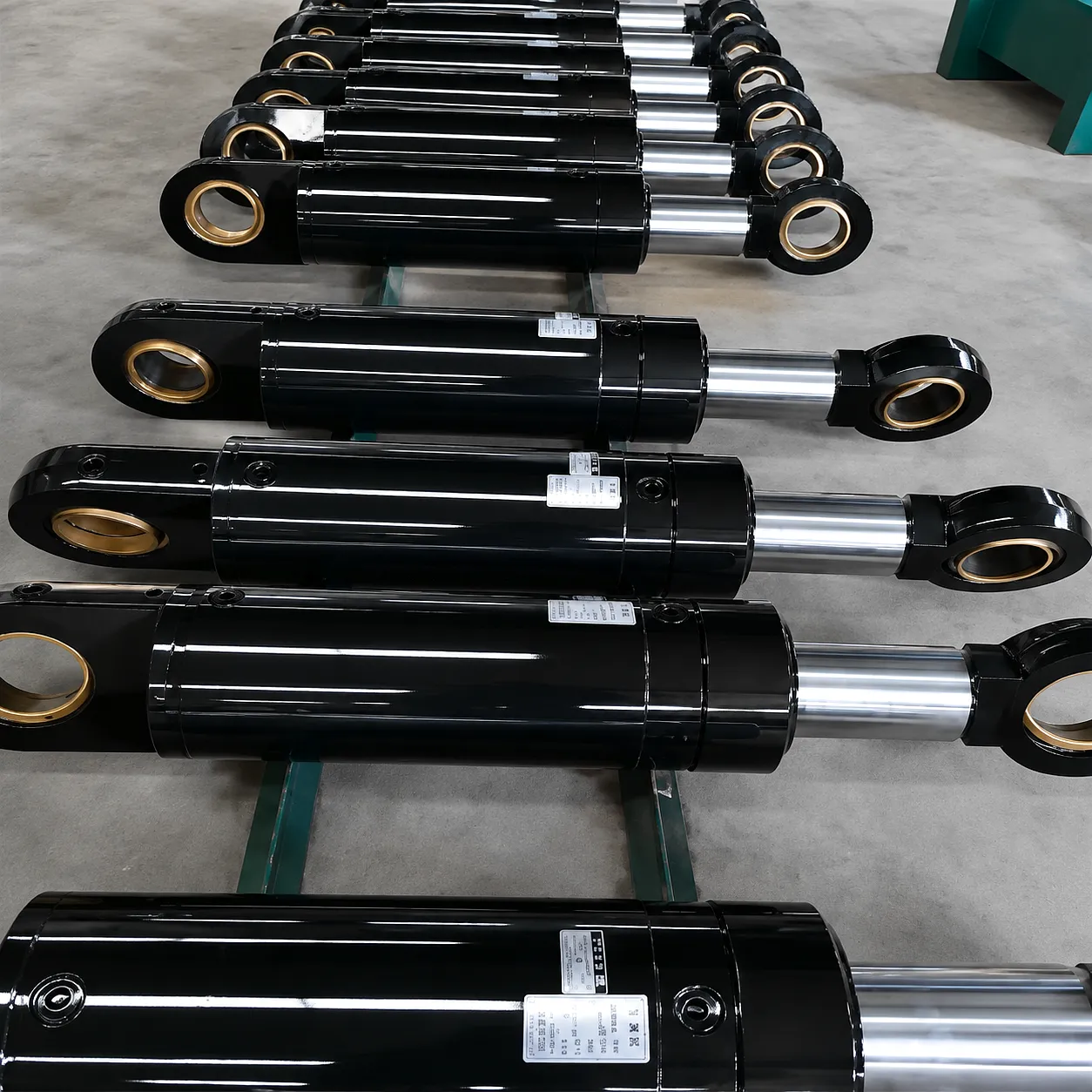
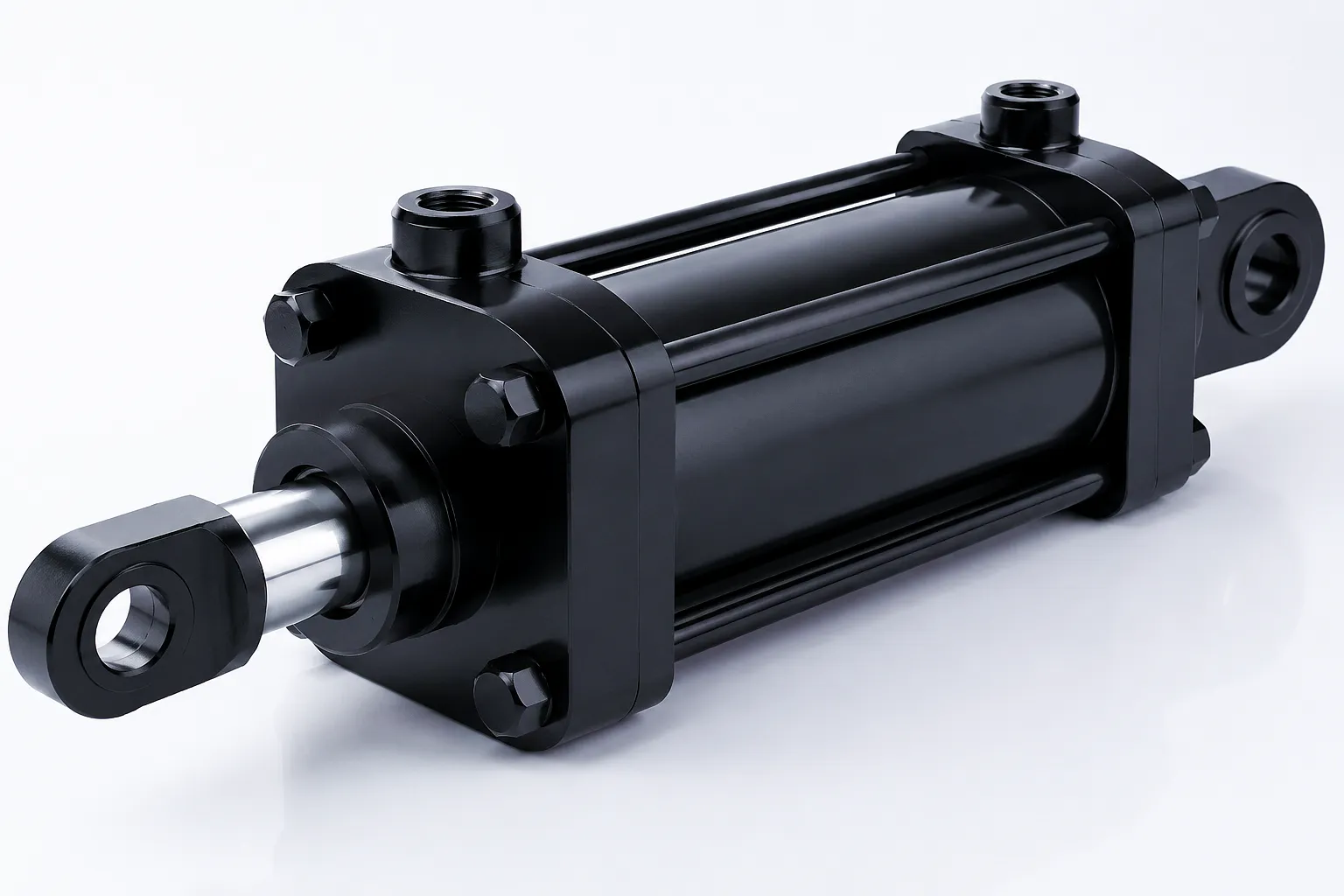
Precision-engineered hydraulic cylinder rods manufactured to ISO tolerances — Ever Power production facility
The Repair Decision: What Engineers Actually Need to Measure
 Before committing to any route, you need hard data — not gut feel, not the word of whoever found the fault on shift. Three measurements define the decision space for a bent hydraulic cylinder rod: total indicated runout (TIR), surface hardness variation, and chrome plating integrity across the damaged zone. TIR is measured by placing the rod between V-blocks or between centres on a lathe bed and rotating it while reading a dial indicator. Industry consensus, reflected in guidance from the British Fluid Power Association (BFPA), is that rods with a TIR exceeding 0.5 mm per metre of rod length are not candidates for straightening and return-to-service. Above that threshold, straightening may remove the visible curvature but cannot remove the residual stress state that will cause the rod to re-bend or fatigue-crack during cyclic loading.
Surface hardness matters because most quality hydraulic rods are manufactured from C45E or 42CrMo4 bar stock that has been induction-hardened to 58–62 HRC at the surface, then ground and chrome-plated. Straightening by three-point pressing or heat application can reduce surface hardness by 15–30% at the deformation zone, destroying the wear resistance that the original heat treatment was designed to provide. A portable Leeb hardness tester used before and after any straightening attempt will reveal whether the metallurgical properties of the rod can be restored — and in most real-world cases with rods bent beyond 0.3 mm/m, they cannot without full annealing, re-machining, and re-plating, at which point the cost almost always exceeds the price of a new rod.
Repair vs Replace: Decision Matrix
| Condition | Repair Viable | Borderline | Replace |
|---|---|---|---|
| TIR runout (per metre) | Below 0.15 mm | 0.15–0.5 mm | Above 0.5 mm |
| Chrome plating integrity | Intact, minor scratches | Localised flaking (< 20 mm) | Cracked / delaminated |
| Surface hardness at bend zone | 55–62 HRC maintained | 50–55 HRC | Below 50 HRC |
| Corrosion / pitting evidence | None | Surface staining only | Any pitting present |
| Operating pressure rating | Below 160 bar | 160–250 bar | Above 250 bar |
| Rod age relative to design life | Below 40% | 40–70% | Above 70% |
| Safety-critical application | No | Low risk category | Yes (PSSR 2000 scope) |
What Rod Repair Actually Involves — and Its Realistic Limitations
Cold straightening presses a bent rod against a support at three points, applying a corrective force that overshoots the target straight position, allowing for springback to bring the rod to within tolerance. The process is fast and low-cost. However, cold working cannot redistribute the internal stress state — it adds new stresses to undo the visible curvature. For rods operating under cyclic pressure above 100 bar, cold-straightened rods have a statistically shorter fatigue life than either a new rod or a thermally stress-relieved rod. The limitation is physics, not technique, and no rod straightening shop can engineer around it entirely.
If the chrome plating has cracked or delaminated, the rod must be stripped to bare steel, re-ground to remove any corrosion or mechanical damage, and then re-plated by electroplating to restore the surface to the correct diameter within h6 or f7 tolerance class. A full re-chrome is not cheap — UK chrome plating shops charge between £150 and £600 for a typical 50–100 mm diameter rod, with turnaround times of one to three weeks depending on queue. The economic justification only holds where the underlying rod geometry, metallurgy, and material condition are sound — and those conditions are rarely all met simultaneously when a rod has bent badly enough to leak.
A repaired rod should never go back into service without full dimensional inspection — TIR below 0.1 mm/m, diameter within drawing tolerance, surface roughness Ra below 0.4 µm across the seal-contact zone, and a final dye penetrant test to confirm no cracks remain. Skipping inspection steps to save time is the single most common reason repaired rods fail earlier than expected. UK plant operators subject to the Provision and Use of Work Equipment Regulations (PUWER) 1998 should document the full inspection record as part of their maintenance records, particularly where the cylinder is part of a load-supporting or personnel-protection function.
Hydraulic Cylinder Rod — Technical & Performance Parameters
Reference specification table — Ever Power standard and custom range
| Parameter | Specification / Range | Notes |
|---|---|---|
| Rod diameter range | 20 mm – 360 mm | Custom sizes available outside range |
| Rod base material | C45E / 42CrMo4 / 17-4PH stainless | Stainless available for offshore, food, marine |
| Surface hardness | 58–62 HRC (induction hardened) | Depth min. 1.5 mm |
| Chrome plating thickness | 20–35 µm (hard chrome) / 80–120 µm (engineered) | HVOF thermal spray option for high-wear environments |
| Surface roughness Ra | 0.2–0.4 µm (seal contact zone) | Per ISO 6194-1 requirements |
| Diameter tolerance | h6 / f7 / e8 to drawing | Measured with digital air-gauge post-plating |
| Max working pressure | Up to 450 bar | Proof tested to 1.5× WP |
| Stroke length | 50 mm – 8,000 mm | Telescopic variants up to 6-stage |
| Operating temperature | -40°C to +150°C | Seal compound selected per application |
| TIR (total indicated runout) | Max 0.1 mm/m (new rod) | Per DIN ISO 4393 |
| Thread end standards | ISO metric / UNC / BSP / custom | UK BSP threads standard on request |
| Cylinder bore options | 25 mm – 500 mm | Honed to Ra 0.4–0.8 µm |
Industrial Application Scenarios Across the UK
Steel Pressing & Metal Forming — Sheffield
Sheffield’s specialty steel and precision forming sector demands hydraulic cylinders that can withstand hundreds of thousands of press cycles without seal degradation or dimensional drift. In these applications, rod replacement on a scheduled interval — typically every 18 months or after a defined number of strokes — is far more cost-effective than waiting for a bend or leak to develop, because unplanned downtime in a busy press shop has a cost that dwarfs the price of a new cylinder assembly. Our hydraulic cylinder rods supplied to Sheffield-area press shops are specified in 42CrMo4 with a minimum chrome plating thickness of 28 µm to handle the abrasive atmosphere in forming areas.
Construction Plant & Excavators — Midlands
Boom, dipper, and bucket cylinders on excavators and telehandlers operating across the Midlands construction corridor — from Birmingham city centre regeneration sites to road-widening schemes on the M6 — are some of the most abuse-prone applications in the hydraulic cylinder world. Rod damage here typically comes from side loading when machines dig against hard ground formations or from operators extending booms beyond their rated reach. When a boom cylinder rod bends on site, the cost question is driven by machine downtime — every hour off-hire represents lost revenue. Ever Power’s range of direct-fit replacement rods, available with next-day despatch from UK logistics stock, specifically addresses this operational reality.
Marine & Offshore — Aberdeen, Tyne & Wear
Hydraulic cylinders in North Sea support vessels, offshore crane systems, and dock ramp actuators face a combination of mechanical loading, salt spray, and temperature cycling that is genuinely hostile to standard carbon steel rods. Corrosion-assisted bending, as described earlier, is a genuine operational hazard in these environments — not a theoretical one. For Aberdeen and Tyne & Wear-based operators specifying replacement cylinders, 316-grade stainless rod, HVOF-coated surface treatment, and double-acting designs with nitrogen-charged accumulators give the service life needed without mandatory annual rod replacement. These specifications are available to order from Ever Power with material test certificates traceable to the mill.
Agricultural Machinery — East Anglia & Yorkshire
Baler, plough, and sprayer hydraulics across the arable belt of Lincolnshire and East Anglia operate seasonally at high intensity, then sit in storage during off-season months — a combination that creates ideal conditions for corrosion at the chrome-to-seal interface. Bent rods in tillage equipment often result from stones in soil impacting extended cylinder rods during field operations. The repair-or-replace decision here is almost always resolved in favour of replacement, because agricultural hydraulic cylinders are low-cost relative to the complexity of a quality rod repair, and harvest season downtime is measured in very real financial loss per hour when conditions are right and the window is short.
Recycling & Waste Processing — Manchester, Leeds
Hydraulic cylinders in baling presses, shredder compactors, and container-handling equipment operated by waste management facilities in Greater Manchester and the West Yorkshire region face some of the most demanding duty cycles in UK industry — continuous operation, contaminated atmospheres, and high shock loading from unpredictable waste material composition. Rod bending in this environment is often a symptom of over-pressurisation events when compressible waste temporarily jams a press. These cylinders are prime candidates for robust replacement units with reinforced rod end connections and high-specification seal packages, rather than field repair.
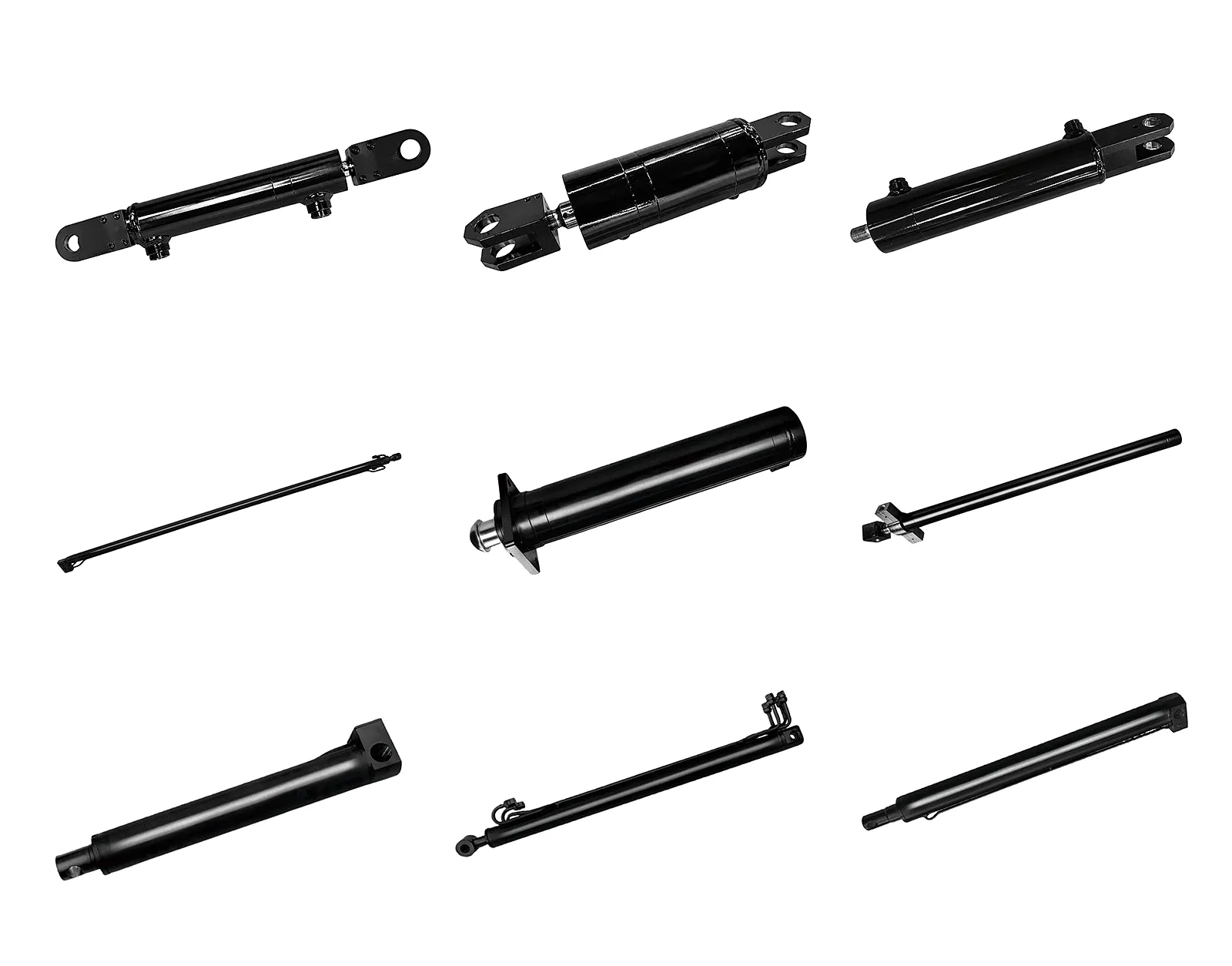
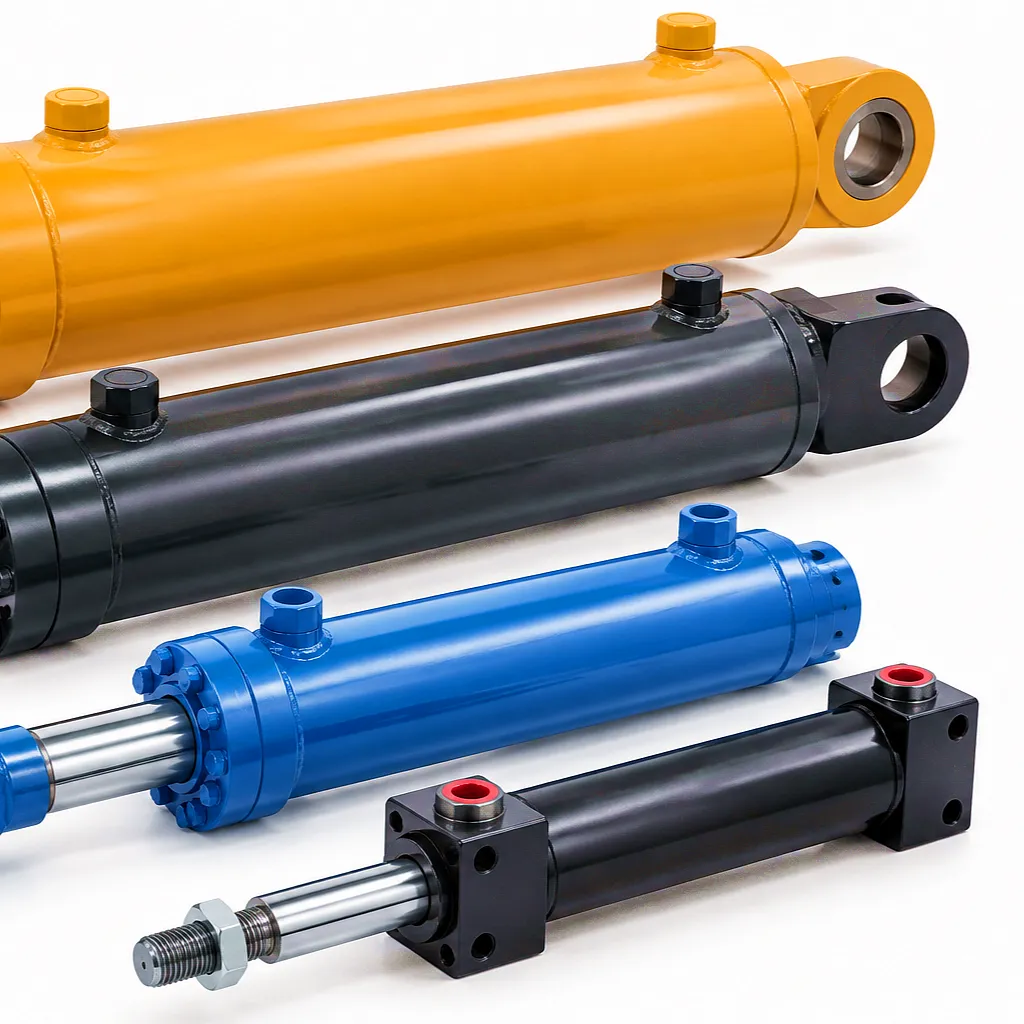
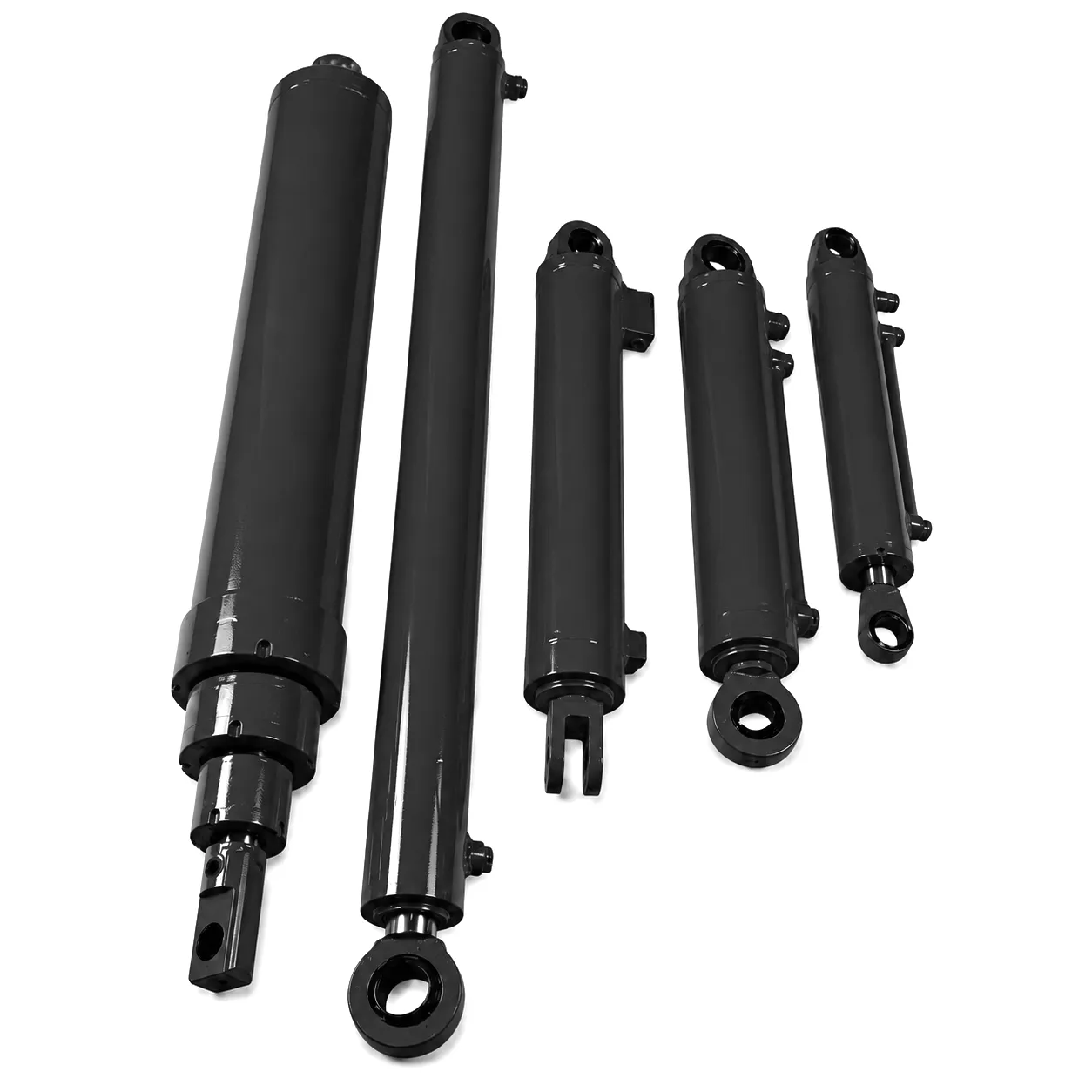
Ever Power hydraulic cylinder product range — engineered for demanding UK and global industrial applications
Material Science Behind Cylinder Rod Bend Resistance
The resistance of a hydraulic cylinder rod to bending is governed by two intersecting properties: the rod’s elastic modulus and its second moment of area — both of which are fixed once the rod geometry and material are chosen. For steel rods of identical diameter, material grade makes less difference to initial stiffness than engineers sometimes assume — all carbon and alloy steels share an elastic modulus of approximately 200 GPa. What material grade genuinely affects is yield strength, and therefore how much load the rod can carry before it permanently deforms. A rod in C45E (yield strength around 490 MPa) will take a permanent set under a lateral load that a rod in 42CrMo4 (yield strength 900–1,100 MPa in the quenched-and-tempered condition) would recover from elastically.
This is why upgrading to a higher-specification rod material is a meaningful engineering decision when a bent rod history points to repeated side loading from the application design rather than accidental damage. If your cylinder’s mounting geometry allows unavoidable angular misalignment beyond 0.5 degrees, or if the effective rod length between bearings exceeds the design guidance for the diameter (typically a slenderness ratio above 40:1 for freely supported ends), a higher-grade rod material buys time but does not solve the underlying loading problem. The correct engineering answer in those cases is to address the mount geometry or the cylinder specification — bore, stroke, and rod diameter — with the supplier, rather than fitting a sequence of progressively better rods into the same flawed installation.
Core Technical Advantages of Ever Power Hydraulic Cylinders
Precision Ground Rods
Every rod ground to h6 tolerance post-plating with surface roughness verified to Ra 0.3 µm using contact profilometry, guaranteeing seal integrity from first stroke.
Induction Hardening
Full-length induction hardening to 58–62 HRC across the seal travel zone, with a tough core preserved for fatigue resistance under cyclic load reversal.
High-Pressure Rating
Standard range rated to 350 bar with custom units available to 450 bar, proof-tested and certified with test report documentation included as standard.
Long Seal Life
Optimised surface finish and chrome thickness selection reduce internal seal friction, cutting operating temperature and extending seal service life by up to 40% compared with lower-specification alternatives.
Full Traceability
Material mill certificates, heat treatment records, dimensional inspection reports, and hydrostatic test certificates supplied with every cylinder — essential for PED 2014/68/EU compliance.
Fast Custom Lead Times
Non-standard bore, stroke, rod diameter, port orientation, and mounting configuration available with lead times from 10 working days for rod assemblies and 15 days for complete cylinder units.
Ever Power — Manufacturing Capability & Customisation Services
Ever Power’s manufacturing facility operates a vertically integrated production chain for hydraulic cylinders — from raw bar stock procurement through to finished assembly and pressure testing. This integration is not just a commercial talking point; it directly controls quality at every stage of production. Where a supply-chain assembler has no visibility into the metallurgy of the rod it buys in, Ever Power’s in-house team selects, inspects, heat-treats, machines, plates, grinds, and seals every cylinder with documented process records at each operation.
The customisation capability spans the full design envelope. UK engineering teams requiring non-standard bore-to-rod ratio combinations — common in retrofit applications where cylinder space is constrained by existing frame geometry — can submit dimensional drawings for review within 24 hours. Position sensing, magnetic piston strips, integrated load cells, and custom port thread forms including BSP, BSPP, and metric DIN fittings are configured at the design stage without the lead time penalties that catalogue-only suppliers impose. For plant managers in Sheffield, Coventry, or Tyneside who have struggled to get the right cilindro hidráulico from domestic distributors, the combination of engineering support and supply-chain depth that Ever Power offers represents a meaningful operational advantage.
Customer Success Story: Sheffield Forge Press Operator Eliminates Repeat Rod Failures
 Hallam Precision Forgings, operating a medium-sized open-die and closed-die forging facility in the Lower Don Valley area of Sheffield, had experienced three separate hydraulic cylinder rod failures across two of their 400-tonne press units over an 18-month period. Each failure followed the same pattern — a gradual bow developing in the 80 mm diameter rod over several weeks of operation, accompanied by increasing oil weep past the rod seal, ultimately resulting in a forced shutdown to swap the cylinder assembly. Each incident cost the facility an average of 14 hours of lost production time, plus rod repair costs from a local hydraulic service centre that were running at approximately £800–£1,200 per event including parts and labour.
The maintenance manager contacted Ever Power after an internet search for UK hydraulic cylinder suppliers capable of providing documented replacement specifications. An Ever Power application engineer reviewed the original cylinder drawings shared by the customer and identified two contributing factors: the rod material in the original design was C45E, and the chrome plating had been applied to a minimum of 15 µm — both below what the cyclic loading duty of the press application genuinely demanded. The recommendation was replacement with 42CrMo4 rods, induction hardened full-length, with 28 µm chrome plating, and the addition of a rod guide bush at the front end to reduce cantilever loading on the seal area during off-centre press operations.
Two complete replacement cylinder assemblies — not just rods — were delivered to the Sheffield facility within three weeks of the order, including dimensional inspection reports and material certificates. At the 12-month mark, neither cylinder has required any unplanned maintenance, and the facility has extended its planned hydraulic cylinder inspection interval from six months to twelve as a result of the improved service life performance.
What Our UK Customers Say
“The 42CrMo4 rods Ever Power supplied to our Sheffield press line have now run for over 14 months without a single rod seal issue. The dimensional quality on delivery was exceptional — our own QC team checked three units against drawing and found every one within h6 tolerance. That level of consistency is something we had not experienced with previous suppliers.”
“We specified stainless rod cylinders for our offshore crane application near Aberdeen, and Ever Power provided material test certificates traceably linked to the original mill batch. The delivery schedule was met, the HVOF surface treatment was exactly what we asked for, and the technical support during the specification phase saved us at least three rounds of revision compared with previous suppliers.”
“When our excavator boom cylinder rod bent during a difficult dig on a Birmingham infrastructure project, we needed a replacement fast — the machine was on daily hire. Ever Power arranged delivery within 48 hours from their UK logistics stock. The replacement rod fitted exactly to the original bore dimensions and we were back in operation the following morning. That turnaround is what makes the difference on a hire fleet.”
When Replacement Is the Only Responsible Answer
There are specific conditions under which no amount of rod straightening, re-plating, or rework will produce a cylinder that can be returned to service safely. Any plant engineer or maintenance manager authorising the return to service of a repaired hydraulic cylinder on a safety-critical application — a vehicle lifting table, a personnel cage hoist, a safety locking mechanism on a press brake, or a marine ramp actuator — should understand these conditions clearly and document why the cylinder in question does not meet them before signing off the work order.
Beyond this threshold, straightening introduces stresses that will cause fatigue failure under dynamic loading regardless of how good the surface quality looks after re-plating.
Circumferential cracks in chrome plating at the bend zone indicate that tensile strain has exceeded the plating’s elongation limit — typically less than 0.5% for hard chrome. The underlying base metal has also yielded at this point.
Pitting creates stress concentrations that multiply local stress by a factor of two to five relative to the nominal rod cross-section, dramatically reducing fatigue life. Pitting combined with any curvature is an automatic replacement trigger.
At high operating pressures, the margin between nominal working stress and failure stress narrows. Any reduction in rod cross-sectional integrity — from bending damage, from re-grinding, from hardness reduction after straightening — brings the rod closer to failure under normal operating conditions.
Cylinders falling within the scope of the Pressure Systems Safety Regulations 2000 in the UK require a written scheme of examination. Returning a repaired rod to service on such equipment without following the written scheme is a legal and insurance liability, not just a technical decision.
Preguntas frecuentes
Need a hydraulic cylinder specialist for your UK industrial application?
✉ Get a Quote from Ever Power — [email protected]
Editado por gzl
 Spanish
  English
  Italian
  Portuguese
  Dutch
Dutch  Swedish
  Danish
  Finnish
  Polish
  Hindi
Hindi  Kazakh
  Turkish
  Ukrainian
  Romanian
  German
  Russian
  Korean
  Japanese
  Vietnamese
  Thai
Thai  Indonesian
  Malay
Malay  French
  Greek
Greek