
Description du produit
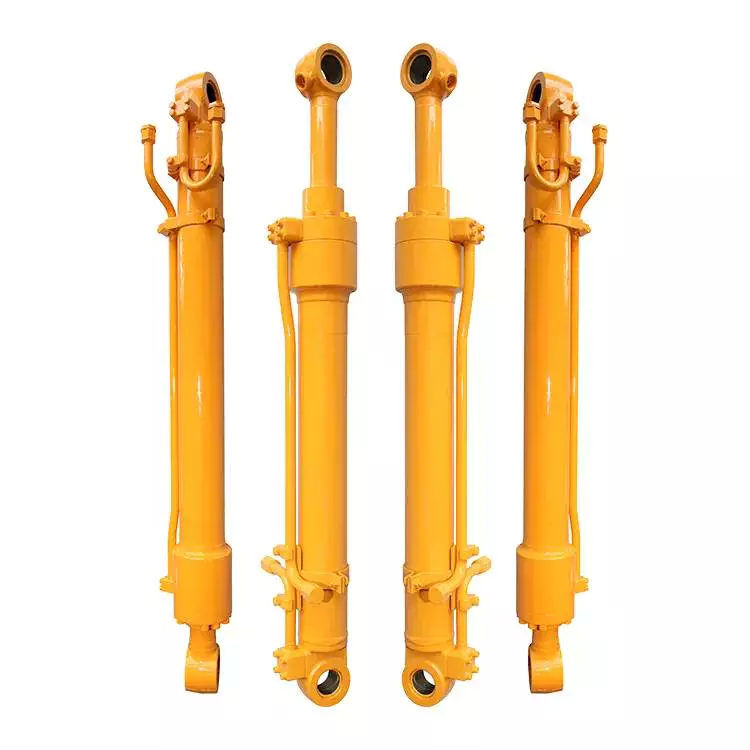
Parker Long Stroke Telescopic Hydraulic Cylinder for Dump Truck
Thin-wall cylinder
1The North America advanced processing technology is adopted to ensured the stable perfprmance
2High quality alloy seamless steel pipe are adopted to keep big liftin capacity and light weight;
3The application of imperial sized makes it easy to replace the seals and other acceessories;
4Superior chrome-plating technology improves the corrosion resistance and hardness of cylinders;
5The world-famous brands of seals such as HALLITE,PARKER and NOK ensure the sealing performance.
Our product:
| Model | The first stage rod diameter | Accident vasculaire cérébral | Closed length | Open length | ||||||||||||
| WTPK 3TG F5*72 | 5″ | 1829mm | 945mm | 2773mm | ||||||||||||
| WTPK 3TG F5*84 | 5″ | 2134mm | 1046mm | 3180mm | ||||||||||||
| WTPK 3TG F5*107 | 5″ | 158/136/116/95 | 1229mm | 3961mm | ||||||||||||
| WTPK 3TG F5*126 | 5″ | 3216mm | 1386mm | 4602mm | ||||||||||||
| WTPK 3TG F6*86 | 6″ | 3216mm | 1038mm | 3241mm | ||||||||||||
| WTPK 3TG F6*104 | 6″ | 2640mm | 1194mm | 3834mm | ||||||||||||
| WTPK 3TG F6*107 | 6″ | 2732mm | 1289mm | 3961mm | ||||||||||||
| WTPK 3TG F6*111 | 6″ | 2819mm | 1268mm | 4087mm | ||||||||||||
| WTPK 3TG F6*120 | 6″ | 3048mm | 1359mm | 4407mm | ||||||||||||
| WTPK 3TG F6*126 | 6″ | 3208mm | 1386mm | 4594mm | ||||||||||||
| WTPK 3TG F6*140 | 6″ | 3562mm | 1519mm | 5081mm | ||||||||||||
| WTPK 5TG F8*170 | 8″ | 4318mm | 1267mm | 5585mm | ||||||||||||
| WTPK 5TG F8*190 | 8″ | 48
Est-il possible d'installer des vérins hydrauliques sur des équipements existants pour en améliorer le fonctionnement ?Oui, il est possible d'installer des vérins hydrauliques sur des équipements existants afin d'en améliorer la fonctionnalité et les performances. Cette installation offre plusieurs avantages, notamment une puissance accrue, un meilleur contrôle, une précision améliorée et une plus grande polyvalence. Voici une explication détaillée de la procédure d'installation de vérins hydrauliques sur des équipements existants pour en optimiser la fonctionnalité : 1. Puissance accrue : L'ajout de vérins hydrauliques permet d'accroître la puissance hydraulique des équipements existants. Grâce à ces vérins, l'équipement peut générer des forces supérieures et supporter des charges plus importantes. Cette puissance accrue lui permet d'accomplir des tâches auparavant difficiles, voire impossibles. Par exemple, l'ajout d'un vérin hydraulique sur une grue peut augmenter sa capacité de levage et lui permettre de manipuler des charges plus lourdes avec une plus grande efficacité. 2. Contrôle amélioré : Les vérins hydrauliques permettent un contrôle précis du mouvement et du positionnement des équipements. Leur installation offre aux opérateurs un meilleur contrôle de la vitesse, de la force et de la direction du mouvement. L'ajout de distributeurs hydrauliques et d'une centrale hydraulique permet un réglage fin du fonctionnement de l'équipement. Ce contrôle amélioré garantit un fonctionnement plus sûr et plus efficace, réduisant les risques de dommages et améliorant la productivité globale. 3. Précision accrue : L'installation de vérins hydrauliques sur des équipements existants permet d'améliorer considérablement leur précision. Les systèmes hydrauliques offrent un contrôle précis des mouvements, garantissant ainsi des déplacements fluides et maîtrisés. Cette précision accrue est particulièrement avantageuse pour les applications exigeant un positionnement précis ou des mouvements répétitifs. Par exemple, l'ajout de vérins hydrauliques à un bras robotisé peut optimiser sa précision et sa répétabilité, le rendant ainsi plus adapté aux tâches nécessitant une grande précision. 4. Polyvalence et adaptabilité : La modernisation des équipements existants grâce à des vérins hydrauliques accroît leur polyvalence et leur adaptabilité. Les systèmes hydrauliques s'intègrent facilement à différents types de machines, permettant ainsi d'exploiter la puissance hydraulique dans diverses applications. La modularité des composants hydrauliques facilite la modernisation et permet aux équipements d'effectuer un plus large éventail de tâches. Cette polyvalence est particulièrement avantageuse dans les secteurs où les équipements doivent s'adapter à l'évolution des besoins opérationnels. 5. Kits de modernisation et personnalisation : Les fabricants proposent souvent des kits de modernisation comprenant tous les composants nécessaires à l'intégration de vérins hydrauliques sur les équipements existants. Ces kits incluent généralement des vérins hydrauliques, des supports de montage, des flexibles, des raccords, des distributeurs et autres accessoires requis. Ils simplifient la modernisation et garantissent la compatibilité entre les composants hydrauliques et l'équipement existant. De plus, les fabricants peuvent proposer des options de personnalisation afin d'adapter la solution de modernisation aux besoins spécifiques de chaque équipement et application. 6. Solution rentable : L'adaptation de vérins hydrauliques à des équipements existants peut s'avérer une solution rentable par rapport à l'achat de machines neuves. En tirant parti de la structure et des composants mécaniques de l'équipement existant, le coût global de la modernisation peut être réduit. Cette solution minimise également les temps d'arrêt, car l'équipement n'a pas besoin d'être entièrement remplacé. De plus, l'amélioration des fonctionnalités et des performances résultant de cette adaptation peut se traduire par une productivité accrue et des économies à long terme. 7. Installation professionnelle et expertise : L'installation de vérins hydrauliques sur des équipements existants requiert souvent l'expertise de professionnels. Collaborer avec des intégrateurs ou des fabricants de systèmes hydrauliques expérimentés garantit une installation correcte, la compatibilité des composants et des performances optimales de la solution. Ces experts sont en mesure d'évaluer l'équipement existant, de recommander les composants hydrauliques adaptés et de mener à bien le processus de modernisation. Leur savoir-faire contribue à l'intégration réussie des vérins hydrauliques et à l'amélioration globale du fonctionnement de l'équipement. En résumé, il est tout à fait possible d'installer des vérins hydrauliques sur des équipements existants afin d'en améliorer le fonctionnement. Cette modernisation offre de nombreux avantages : puissance accrue, contrôle amélioré, précision renforcée, polyvalence, rentabilité et accès à des kits de modernisation et des options de personnalisation. Grâce à l'installation de vérins hydrauliques, les équipements existants peuvent être mis à niveau pour répondre à l'évolution des besoins opérationnels, prolonger leur durée de vie et optimiser leurs performances globales.
Utilizing Hydraulic Cylinders in Conjunction with Alternative Energy SourcesHydraulic cylinders can indeed be used in conjunction with alternative energy sources. The versatile nature of hydraulic systems allows them to be integrated with various alternative energy technologies to enhance efficiency, control, and power generation. Let’s explore some examples of how hydraulic cylinders can be utilized alongside alternative energy sources:
In summary, hydraulic cylinders can be effectively utilized in conjunction with alternative energy sources to enhance energy storage, power generation, and control. Whether it’s through hydraulic energy storage systems, wave and tidal energy conversion, hydroelectric power generation, hydraulic actuation in wind turbines, or geothermal energy extraction, hydraulic cylinders offer versatile and efficient solutions for harnessing and utilizing alternative energy sources.
What factors should be considered when selecting the right hydraulic cylinder for an application?When selecting the right hydraulic cylinder for an application, several important factors need to be considered. These factors help ensure that the chosen hydraulic cylinder is suitable for the specific requirements of the application and will perform reliably. Here are the key factors to consider: 1. Load Requirements: – One of the crucial factors to consider is the load requirement of the application. Determine the maximum load that the hydraulic cylinder needs to handle. Consider both the static load (when the cylinder is stationary) and the dynamic load (when the cylinder is in motion). The load requirement will impact the cylinder’s bore size, rod diameter, and overall strength. Choose a hydraulic cylinder with a load capacity that exceeds the application’s maximum load to ensure safety and longevity. 2. Stroke Length: – The stroke length refers to the distance the hydraulic cylinder needs to extend and retract to perform the desired motion. Measure the required stroke length based on the application’s operational requirements. It is essential to choose a hydraulic cylinder with a stroke length that matches or exceeds the required distance. Consider any potential variations or adjustments in the stroke length that may be needed in the future. 3. Operating Pressure: – Consider the operating pressure required for the application. The hydraulic cylinder must be capable of withstanding the maximum pressure within the hydraulic system. Ensure that the selected cylinder has a pressure rating that exceeds the application’s maximum operating pressure. This ensures safety and prevents premature failure. 4. Speed Requirements: – Determine the required speed of the hydraulic cylinder’s movement for the application. Consider both the extension and retraction speeds. Select a cylinder that can achieve the desired speed while maintaining precise control and stability. It is important to choose a cylinder that can handle the required speed without compromising performance or safety. 5. Mounting: – Evaluate the available space and mounting requirements for the hydraulic cylinder. Consider the mounting type (such as flange, foot, trunnion, or clevis), the available mounting points, and any specific mounting constraints. Ensure that the selected cylinder can be easily and securely mounted in the desired location. 6. Environmental Factors: – Assess the environmental conditions in which the hydraulic cylinder will operate. Consider factors such as temperature extremes, humidity, exposure to chemicals, dust, or corrosive substances. Choose a cylinder that is designed to withstand the specific environmental conditions of the application. This may involve selecting appropriate materials, coatings, or seals to ensure the longevity and performance of the cylinder. 7. Cylinder Configuration: – Determine the appropriate cylinder configuration based on the application’s requirements. Consider factors such as single-acting or double-acting cylinders, telescopic cylinders for limited space, or custom configurations for unique applications. Evaluate the specific needs of the application to select the most suitable cylinder configuration. 8. Maintenance and Serviceability: – Consider the maintenance and service requirements of the hydraulic cylinder. Evaluate factors such as ease of access for maintenance, availability of spare parts, and the reputation of the manufacturer or supplier in terms of customer support and after-sales service. Choosing a reliable and reputable brand can ensure ongoing support and availability of spare parts when needed. 9. Compliance and Standards: – Depending on the industry and application, certain compliance standards may need to be met. Consider any industry-specific regulations, safety standards, or certifications that the hydraulic cylinder should comply with. Ensure that the selected cylinder meets the required standards and certifications for the application. 10. Cost and Budget: – Finally, consider the cost and budget for the hydraulic cylinder. While it is important to select a cylinder that meets the application’s requirements, it is also necessary to consider the overall cost-effectiveness. Evaluate the initial purchase cost, long-term maintenance costs, and the expected lifespan of the cylinder. Balancing the cost and quality will help in selecting a hydraulic cylinder that provides the best value for the application. By considering these factors in the selection process, it becomes possible to choose the right hydraulic cylinder that meets the specific requirements of the application in terms of load capacity, stroke length, operating pressure, speed, mounting, environmental conditions, maintenance needs, compliance, and cost-effectiveness. Proper selection ensures optimal performance, reliability, and longevity of the hydraulic cylinder in the intended application.
|


 French
  English
  Italian
  Portuguese
  Dutch
Dutch  Swedish
  Danish
  Finnish
  Polish
  Hindi
Hindi  Kazakh
  Turkish
  Ukrainian
  Romanian
  Spanish
  German
  Russian
  Korean
  Japanese
  Vietnamese
  Thai
Thai  Indonesian
  Malay
Malay  Greek
Greek