
Penerangan Produk
Product Advantage:
1. Safer Junfu hydraulic cylinder adopts excellent structural design and new material application, which can withstand the harshest working conditions and continue to work stably without disconnection, ensuring the safety of drivers and vehicles, and creating the most valuable safety for users.
2. faster unloading
Junfu series oil cylinder adopts excellent structural design to improve the unloading speed of the oil cylinder!
3.higher lift frequency
junfu series oil cylinders are suitable for all-weather short barge and high-frequency operations, with stable performance, extremely low failure rate, increasing the number of transfers and reducing downtime!
4. Greater adaptability to the environment
junfu series oil cylinder adopts innovative sealing technology and new material application, which can adapt to the temperature range of -40~110ºC, and can achieve excellent performance in high temperature and low temperature environment operation!
5. lighter
Compared with other products of the same series, CHINAMFG series cylinders reduce the dead weight by 15%~20%, and increase the lifting force by 10%~15%!
6. Greater lifting force
Compared with other products of the same series, the lifting force of CHINAMFG series cylinders is increased by 10%~15%. More lift, more load, more profit! Lighter dead weight, greater lifting force, more lightness!
Enterprise Certificate
Our partner
Our Service
Soalan Lazim:
Q1: How about the quality?
Our cylinders can replace HYVA cylinder well, with same technical details and mounting sizes
Q2: What’s your cylinder’s advantages ?
The cylinders are manufactured by advanced equipments and made under strictly quality control processing.
The steel is tempered and all raw materials are good quality from world famous companies.
Competitive price!
Q3: When your company be established ?
Our company be established in 2002, professional manufacturer of hydraulic cylinders more than 20 years.
We had passed IATF 16949:2016 Quality control system, ISO9001, CE.
Q4: How about the delivery time ?
15 days approximately.
Q5: How about the cylinder’s quality gurantee ?
One year.
| Pensijilan: | GS, CE, ISO9001, SGS |
|---|---|
| Tekanan: | High Pressure |
| Suhu Kerja: | Suhu Biasa |
| Sampel: | US$ 800/Piece 1 Keping (Pesanan Minimum) | Order Sample |
|---|
| Penyesuaian: | Tersedia |
|
|---|
.shipping-cost-tm .tm-status-off{background: none;padding:0;color: #1470cc}
| Shipping Cost: Estimated freight per unit. | about shipping cost and estimated delivery time. |
|---|
| Payment Method: |
|
|---|---|
| Initial Payment Full Payment |
| Currency: | US$ |
|---|
| Return&refunds: | You can apply for a refund up to 30 days after receipt of the products. |
|---|
Can hydraulic cylinders be integrated with modern telematics and remote monitoring?
Yes, hydraulic cylinders can indeed be integrated with modern telematics and remote monitoring systems. The integration of hydraulic cylinders with telematics and remote monitoring technology offers numerous benefits, including enhanced operational efficiency, improved maintenance practices, and increased overall productivity. Here’s a detailed explanation of how hydraulic cylinders can be integrated with modern telematics and remote monitoring:
1. Sensor Integration:
– Hydraulic cylinders can be equipped with various sensors to gather real-time data about their performance and operating conditions. Sensors such as pressure transducers, temperature sensors, position sensors, and load sensors can be integrated directly into the cylinder or its associated components. These sensors provide valuable information about parameters such as pressure, temperature, position, and load, enabling remote monitoring and analysis of the cylinder’s behavior.
2. Data Transmission:
– The data collected from the sensors in hydraulic cylinders can be transmitted wirelessly or through wired connections to a central monitoring system. Wireless communication technologies such as Bluetooth, Wi-Fi, or cellular networks can be employed to transmit data in real-time. Alternatively, wired connections such as Ethernet or CAN bus can be utilized for data transmission. The choice of communication method depends on the specific requirements of the application and the available infrastructure.
3. Remote Monitoring Systems:
– Remote monitoring systems receive and process the data transmitted from hydraulic cylinders. These systems can be cloud-based or hosted on local servers, depending on the implementation. Remote monitoring systems collect and analyze the data to provide insights into the cylinder’s performance, health, and usage patterns. Operators and maintenance personnel can access the monitoring system through web-based interfaces or dedicated software applications to view real-time data, receive alerts, and generate reports.
4. Condition Monitoring and Predictive Maintenance:
– Integration with telematics and remote monitoring enables condition monitoring and predictive maintenance of hydraulic cylinders. By analyzing the collected data, patterns and trends can be identified, allowing for the detection of potential issues or anomalies before they escalate into major problems. Predictive maintenance algorithms can be applied to the data to generate maintenance schedules, recommend component replacements, and optimize maintenance activities. This proactive approach helps prevent unexpected downtime, reduces maintenance costs, and maximizes the lifespan of hydraulic cylinders.
5. Performance Optimization:
– The data collected from hydraulic cylinders can also be utilized to optimize their performance. By analyzing parameters such as pressure, temperature, and load, operators can identify opportunities for improving operational efficiency. Insights gained from the remote monitoring system can guide adjustments in system settings, load management, or operational practices to optimize the performance of hydraulic cylinders and the overall hydraulic system. This optimization can result in energy savings, improved productivity, and reduced wear and tear.
6. Integration with Equipment Management Systems:
– Telematics and remote monitoring systems can be integrated with broader equipment management systems. This integration allows hydraulic cylinder data to be correlated with data from other components or related machinery, providing a comprehensive view of the overall system’s performance. This holistic approach enables operators to identify potential interdependencies, optimize system-wide performance, and make informed decisions regarding maintenance, repairs, or upgrades.
7. Enhanced Safety and Fault Diagnosis:
– Telematics and remote monitoring can contribute to enhanced safety and fault diagnosis in hydraulic systems. Real-time data from hydraulic cylinders can be used to detect abnormal conditions, such as excessive pressure or temperature, which may indicate potential safety risks. Fault diagnosis algorithms can analyze the data to identify specific issues or malfunctions, enabling prompt intervention and reducing the risk of catastrophic failures or accidents.
In summary, hydraulic cylinders can be effectively integrated with modern telematics and remote monitoring systems. This integration enables the collection of real-time data, remote monitoring of performance, condition monitoring, predictive maintenance, performance optimization, integration with equipment management systems, and enhanced safety. By harnessing the power of telematics and remote monitoring, hydraulic cylinder users can achieve improved efficiency, reduced downtime, optimized maintenance practices, and enhanced overall productivity in various applications and industries.
Ensuring Stable Performance of Hydraulic Cylinders Under Fluctuating Loads
Hydraulic cylinders are designed to provide stable performance even under fluctuating loads. They achieve this through various mechanisms and features that allow for efficient load control and compensation. Let’s explore how hydraulic cylinders ensure stable performance under fluctuating loads:
- Piston Design: The piston inside the hydraulic cylinder plays a crucial role in load control. It is typically equipped with seals and rings that prevent leakage of hydraulic fluid and ensure effective transfer of force. The piston design may incorporate features such as stepped or tandem pistons, which provide enhanced load-bearing capabilities and improved stability by distributing the load across multiple surfaces.
- Cylinder Cushioning: Hydraulic cylinders often incorporate cushioning mechanisms to minimize the impact and shock caused by fluctuating loads. Cushioning can be achieved through various methods, such as adjustable cushion screws, hydraulic cushioning valves, or elastomeric cushioning rings. These mechanisms slow down the piston’s movement near the end of the stroke, reducing the impact and preventing sudden stops that could lead to instability.
- Pressure Compensation: Fluctuating loads can result in pressure variations within the hydraulic system. To ensure stable performance, hydraulic cylinders are equipped with pressure compensation mechanisms. These mechanisms maintain a consistent pressure level in the system, regardless of load changes. Pressure compensation can be achieved through the use of pressure relief valves, compensating pistons, or pressure-compensated flow control valves.
- Flow Control: Hydraulic cylinders often incorporate flow control valves to regulate the speed of the cylinder’s movement. By controlling the flow rate of hydraulic fluid, the cylinder’s motion can be adjusted to match the changing load conditions. Flow control valves allow for smooth and controlled movement, preventing abrupt changes that could lead to instability.
- Feedback Systems: To ensure stable performance under fluctuating loads, hydraulic cylinders can be integrated with feedback systems. These systems provide real-time information on the cylinder’s position, velocity, and force. By continuously monitoring these parameters, the hydraulic system can make immediate adjustments to maintain stability and compensate for load fluctuations. Feedback systems can include position sensors, pressure sensors, or load sensors, depending on the specific application.
- Proper Sizing and Selection: Ensuring stable performance under fluctuating loads starts with proper sizing and selection of hydraulic cylinders. It is crucial to choose cylinders with appropriate bore size, rod diameter, and stroke length to match the anticipated load conditions. Oversized or undersized cylinders can lead to instability and reduced performance. Proper sizing also involves considering factors such as the required force, speed, and duty cycle of the application.
In summary, hydraulic cylinders ensure stable performance under fluctuating loads through features such as piston design, cushioning mechanisms, pressure compensation, flow control, feedback systems, and proper sizing and selection. These mechanisms and considerations allow hydraulic cylinders to provide consistent and controlled movement, even in dynamic load conditions, resulting in reliable and stable performance.
Bagaimanakah pengeluar memastikan kualiti dan keserasian silinder hidraulik?
Pengilang menggunakan pelbagai langkah untuk memastikan kualiti dan keserasian silinder hidraulik, memastikan ia memenuhi piawaian industri, keperluan prestasi dan keperluan khusus pelanggan mereka. Berikut ialah penjelasan terperinci tentang kaedah dan amalan yang digunakan oleh pengeluar untuk memastikan kualiti dan keserasian silinder hidraulik:
1. Reka Bentuk dan Kejuruteraan:
– Pengilang menggaji jurutera dan pereka mahir yang mempunyai kepakaran dalam sistem hidraulik dan reka bentuk silinder. Mereka menggunakan perisian dan alatan reka bentuk canggih untuk mencipta silinder hidraulik yang memenuhi spesifikasi dan keperluan prestasi yang dikehendaki. Melalui analisis dan simulasi yang teliti, pengeluar boleh memastikan bahawa silinder direka bentuk untuk berfungsi secara optimum dan memberikan daya, panjang lejang dan kebolehpercayaan yang diperlukan.
2. Pemilihan Bahan:
– Bahan berkualiti tinggi adalah penting untuk ketahanan, prestasi dan keserasian silinder hidraulik. Pengilang memilih bahan seperti keluli atau aloi lain dengan teliti berdasarkan kekuatan, rintangan kakisan dan kesesuaiannya untuk aplikasi hidraulik. Mereka mendapatkan bahan daripada pembekal yang bereputasi dan menjalankan pemeriksaan kualiti untuk memastikan bahan tersebut memenuhi piawaian dan spesifikasi yang diperlukan.
3. Kawalan Kualiti:
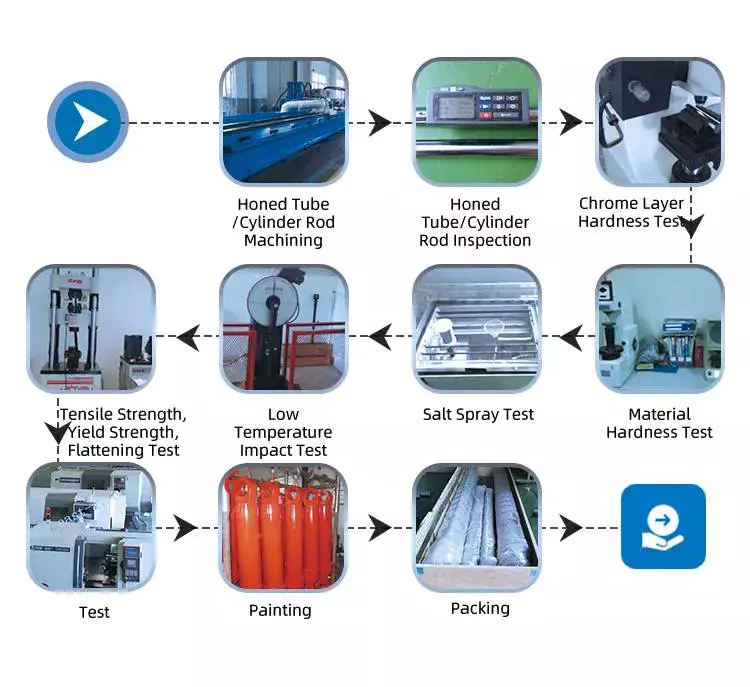
– Pengilang melaksanakan proses kawalan kualiti yang mantap sepanjang pengeluaran silinder hidraulik. Ini termasuk pemeriksaan dan ujian yang ketat pada pelbagai peringkat pembuatan, daripada pemeriksaan bahan mentah hingga pemasangan akhir. Kakitangan kawalan kualiti menjalankan pemeriksaan dimensi, pemeriksaan kemasan permukaan dan ujian fungsi untuk mengesahkan bahawa silinder memenuhi toleransi, kriteria prestasi dan keperluan keserasian yang ditetapkan.
4. Pengujian dan Pengesahan:
– Silinder hidraulik menjalani prosedur pengujian dan pengesahan untuk memastikan prestasi, kebolehpercayaan dan keserasiannya. Pengilang menjalankan pelbagai ujian, seperti ujian tekanan, ujian kebocoran, ujian beban dan ujian ketahanan. Ujian ini mensimulasikan keadaan operasi dunia sebenar dan mengesahkan bahawa silinder dapat menahan beban, tekanan dan faktor persekitaran yang dijangkakan. Di samping itu, pengeluar mungkin melakukan ujian keserasian untuk memastikan silinder dapat disepadukan dengan lancar dengan komponen sistem hidraulik yang lain.
5. Pematuhan dengan Piawaian:
– Pengilang mematuhi piawaian dan peraturan industri untuk memastikan kualiti dan keserasian silinder hidraulik. Mereka mematuhi piawaian seperti ISO 9001 untuk sistem pengurusan kualiti dan ISO 6020/2 atau ISO 6022 untuk silinder hidraulik. Pematuhan dengan piawaian ini memastikan proses pembuatan, langkah kawalan kualiti dan prestasi produk memenuhi penanda aras yang diiktiraf di peringkat antarabangsa.
6. Pensijilan dan Akreditasi:
– Pengilang boleh mendapatkan pensijilan dan akreditasi daripada organisasi yang diiktiraf untuk menunjukkan komitmen mereka terhadap kualiti dan keserasian. Pensijilan seperti pensijilan ISO atau pensijilan pihak ketiga memberikan jaminan kepada pelanggan bahawa silinder hidraulik telah menjalani penilaian yang ketat dan memenuhi piawaian kualiti dan keserasian tertentu.
7. Kerjasama Pelanggan:
– Pengilang secara aktif berinteraksi dengan pelanggan untuk memahami keperluan khusus mereka dan memastikan keserasian. Mereka bekerjasama rapat dengan pelanggan untuk mengumpulkan butiran khusus aplikasi, seperti keadaan operasi, keperluan beban dan faktor persekitaran. Pendekatan kolaboratif ini membolehkan pengeluar menyesuaikan silinder hidraulik dan menyediakan penyelesaian yang sepadan dengan keperluan pelanggan, memastikan keserasian dan prestasi optimum.
8. Penambahbaikan Berterusan:
– Pengilang komited terhadap penambahbaikan berterusan dalam proses dan produk mereka. Mereka melabur dalam penyelidikan dan pembangunan untuk menggabungkan teknologi, bahan dan teknik pembuatan terkini. Dengan sentiasa mengikuti perkembangan industri, pengeluar boleh meningkatkan kualiti, prestasi dan keserasian silinder hidraulik mereka dari semasa ke semasa.
Dengan melaksanakan amalan reka bentuk dan kejuruteraan yang berkesan, memilih bahan berkualiti tinggi, menjalankan kawalan kualiti, prosedur pengujian dan pengesahan yang ketat, mematuhi piawaian industri, mendapatkan pensijilan, bekerjasama dengan pelanggan dan melaksanakan penambahbaikan berterusan, pengeluar memastikan kualiti dan keserasian silinder hidraulik. Langkah-langkah ini membantu menghasilkan silinder berprestasi tinggi yang andal dan memenuhi pelbagai keperluan industri dan aplikasi.

editor by CX 2023-10-20
 Malay
Malay  English
  Italian
  Portuguese
  Dutch
Dutch  Swedish
  Danish
  Finnish
  Polish
  Hindi
Hindi  Kazakh
  Turkish
  Ukrainian
  Romanian
  Spanish
  German
  Russian
  Korean
  Japanese
  Vietnamese
  Thai
Thai  Indonesian
  French
  Greek
Greek